Showing posts with label heritage. Show all posts

Monday, April 21, 2008

Dialects spark new bonding

Article in TODAY "Dialects spark new bonding" (21 Apr 2008) highlighted the debate regarding teaching dialect versus mandarin chinese in schools. Personally, I would have greatly appreciated the opportunity to learn dialect in school! I actually had to go all the way downtown, pay a school fee to learn Teochew last year! Even still, it was only once a week. Now I learnt that there are lessons for Hokkien too.

For people like me who are from mixed dialect families, and not having constant exposure to any one dialect, lessons are perfect. It really helps me become closer to my family, my heritage and my culture. I actually have to practice Teochew with my Teochew PhD colleagues from China. We spent the days exploring how the dialect has evolved and comparing notes between Hokkien and Teochew. I never realized how much the dialect groups in Singapore has truly integrated until I talk to them and find out the isolation amongst the different areas in China, even within a dialect group itself.

I lament the fact that I do not know my dialects better so I can better communicate with my grandparents' generation. When I went with Jen Lee to interview Mr Tan Hai Liang, I felt frustrated that I could understand but could not communicate my thoughts and questions with him. So frustrating! What more, with each passing day, these elderly treasures trove of knowledge and information is slipping away from us. Without the right communication tool, how can we possibly connect with them?

I wish more Singaporeans would learn dialects and stay in touch with their heritage. We have such a full and interesting history and heritage that really gives a boost to our identity. Likewise, for any other ethnic group, getting to know our roots and dialects of our people (and mind you, not only Chinese have dialects!) would really spark new bonding.

Dialects spark new bonding
By Lin Yanqin, TODAY
21 April 2008

For years, English and officially-termed "Mother Tongues" ruled the classrooms, while dialects — such as Hokkien or Hakka — languished at home, in private conversations, perhaps used occasionally when communicating with one's elderly grandparents and neighbours.

Such was the result of Singapore's decades-old policy of bilingualism — launched in 1966 — where dialects were banned from use on radio and television programmes, and the "Speak Mandarin" campaign was born to create a new generation of Singaporean-Chinese who speak a common second language: Mandarin.

But with dialects in danger of becoming a lost art and a younger generation unable to communicate with their grandparents, it looks like the time has come to break the long-time taboo against dialects and start introducing it in schools.

In fact, dialects are no longer being kept away from schools when once upon a time, it was felt that they impeded the learning of Mandarin — and are showing up in the form of enrichment modules and electives.

It was Member of Parliament (MP) Baey Yam Keng who floated the idea of teaching dialects as a third language during the Budget debates in March.

Schools, he said then, could play a bigger role in educating the youth about cultures he feared would someday "become an artefact in a museum".

Yesterday, he told Today: "I just think it's a waste if we don't make some effort to preserve dialects. They are a big part of Chinese culture, so to understand our own culture and roots and to promote it to other racial groups, you have to bring in dialects."

According to the Chinese Learning Lab chief executive Chua Chee Lay, who is writing a book on the impact of Singapore's language policy, dialects were "a big problem" for the Government in the '50s and '60s.

"There was no common language, so communication was a problem. And there were also gangs — people were divided because of language ideology," said Dr Chua.

To "clean up the mess", the "Speak Mandarin" campaign was introduced in 1979. "You can say it has been successful, because dialects are a dying language in Singapore," he said. "But with the creation of a common language, dialects are no longer a threat."

Agreeing, Mr Baey said: "A lot of youths nowadays might not even know what dialect groups they are from. I don't see a danger of baggage from the past reappearing."

Some schools have started introducing aspects of traditional Chinese culture, including dialects, as electives and enrichment modules for their students.

Such modules could be one-off, special activities for students, or yearly modules conducted over a week.

At SAP school Dunman High, third-year students take a module called "Pop Song Culture", where students are introduced to dialect pop songs in the 70s and 80s to learn about pop culture in different dialect groups. They also take an elective to the different flavours and food cultures from various dialect groups.

Even so, vice-principal Low Joo Hong was cautious about departing from the long-time emphasis on bilingualism. "I think it is a sensitive issue, because on one hand you want students to keep their roots, but you don't want to overplay dialects because in our history, it has become an issue when people become over-assertive about their own identity," he said.

And even as some argue that there is value in introducing dialects in schools as an enrichment activity, others question the value of doing so and whether it will interfere with learning Mandarin.

"Culturally, I see its importance, but in the overall scheme of things, is it useful," asked MP Chan Soo Sen. "I would leave it the student – if a student wants to take, then he should not be denied the opportunity," he added.

Teochew Poit Ip Huay Kuan secretary Baey Teng Mong, lamenting the low level of interest in dialects, said: "People see no economic value in it."

The Education Ministry's official line reiterates: "Mandarin is the unifying spoken language for Singaporean Chinese".

But Nanyang Girls' High School's (NYGH) dean of pupil development Teo Yong Hong had this take. "I personally see no conflict in teaching dialects and Chinese; it could even enliven their interest in Mandarin," she said, adding that students might find dialects useful when doing community service, as many elderly people have problems understanding Mandarin.

In that aspect, dialects would bond rather than divide, said Singapore Hokkien Huay Kuan's Tan Kian Choo, chairman of the association's education committee.

"It helps the younger generation and the educated communicate with the older generation and the less educated. Among peers, it is a natural bond," he said. - TODAY/ra


Read full article here

Tuesday, March 11, 2008

History & Heritage Talks

For those interested in the history and heritage of Singapore, there are a series of upcoming talks which you may find interesting.

The National Museum of Singapore is organizing a series of talks over 6 saturdays which will provide an introduction to the history of Singapore.


Click on image for full size

On 24 March 2008, a Master candidate from the Department of History will be talking about the management of Kusu Island, focusing primarily on the temple and visitorship to the island. More information in the full article.

Managing The Tortoise Island:
Tua Pek Kong Temple, Pilgrimage, and Social Change in Pulau Kusu, 1965-2007


Speaker:
Chia Meng Tat Jack,
Department of History,
National University of Singapore

Chair:
Tan Shiling Cheryl,
Department of Sociology,
National University of Singapore

Date:
Monday, 24 March 2008

Venue:
Faculty of Arts and Social Sciences
Blk AS7, Level 6
Research Clusters Meeting Room A
Time: 3.00 – 4.30pm

Abstract:
This essay examines the Guiyu Fushangong Tua Pek Kong Temple龟屿福善宫大伯公庙and religious activities in Pulau Kusu as they intersect with the larger forces of social change, state management, and development of the Southern Islands since the independence of Singapore for the period from 1965 to the present. It contends that the state’s interest in the economic potential of the Tua Pek Kong Temple, and the attempt to seek profit from its religious activities in particular over the last two decades, has very much affected the temple and contributed to the commercialization and “touristization” of the island. The state authorities have tried to reduce the autonomy of Pulau Kusu, exerting more control over the temple, and management of the island. They also sought to profit from the religious activities, as seen from their monopoly of goods and services, promotion of commercial activities, and their attempt to transform the island into a tourist site.

About the Speaker:
Chia Meng Tat Jack is a MA Candidate in history at the National University of Singapore. His research interests include Buddhism, Chinese popular religions, and the Chinese diaspora in Malaysia and Singapore. He is currently researching on the transnational temple-association networks connecting the Nanan community in Singapore with China and Malaysia

Light refreshments will be provided!

We gratefully request that you RSVP with your name, affiliation, contact details, to Jack Chia at: mengtat@nus.edu.sg.


Read full article here

Tuesday, March 04, 2008

Video from the Singapore Flyer capsule


Because I have nothing better to do, here's the video I took on the night of 1st March 2008, the first day the singapore flyer was open to public.


Read full article here

Monday, March 03, 2008

On the Singapore Flyer


1 March 2008 was the first day of public rides for the observatory wheel, Singapore Flyer. What more, the birthdate of the singapore flyer also coincided with my mom's birthday. As such, the whole family celebrated her birthday on the flyer. Unfortunately, it was only till later that we realized that others did the same but even got cake and fanfare from the media. Alas my mother has to make do with a "signature cocktail" and a souvenir which we paid dearly for.

While I'm not a fan of its mere existence, I must say the singapore flyer does provide a spectacular vantage view of the city. You are able to keep track of quite a bit of things on the top of the world. Although I was corrected by my equally excited nephew that this is hardly the top of the world *grin*


For one, I definitely appreciate the fact that I managed to get one last glimpse of the Kallang Stadium before it gives way to the new "sports hub". I will miss those overpowering stadium lights.

The experience dealing with the Singapore Flyer has been painful to say to least for me. I blame it on birthing hiccups but the line at the flyer was painful for those waiting for a chance on the flyer. We were just glad we paid through our teeth to get the express line. I did take a video which I will blog about once I get over the fatigue of the weekend's activities.

Photos on flickr


Read full article here

Monday, August 27, 2007

The value of feedback

I must admit in advance that my feedback today came about 15 days too late. When the 7th lunar month swung around 15 days ago, my family noticed that a large number of people in my estate were burning the joss paper on the floor and the grass instead of the usually-provided metal drums that serves as joss paper burners. I should have called the town council as I promised my dad 15 days ago but alas, I hope it is not too late!

We discovered that the phenomenon is due to the fact that after upgrading, the usual ratio of 2 burners to 1 block has now been reduced to something like 1 burner to 3 blocks. As such, many people were met with little choice but to burn as and where they can. [update: a detailed count is needed. I think the problem is one of unequal distribution]

This is seriously bad as I recall that this Chinese New Year, we had to queue up for the miserable 2 or 3 burners in the entire estate and the burners were so filled to the brim that things were spilling out. I guess as people become richer, the things they wish to offer to the gods and to the dead also increases. Naturally, we need more bins.

Today, being the 15th day of the 7th lunar month, is the "peak period" of the hungry ghost festival where chinese people believe the gates of hell are opened and the dead gets to roam the earth for a month. Coinciding with the full month, getai or staged variety shows and traditional chinese opera are performed for the dead as well as banquets, auctions for fundraising, prayers and lots of burning. Although my mom has no idea what is the reason for offerings on the midpoint of the month but there will be yet another offering ritual at the closing of the festival month.

As I was coming to school earlier, I noted that the problem of paper burner shortages has not been solved and 3 freshly burnt patches along the sidewalk was seen. As such, a quick call to the town council had them promising to send people to increase the joss paper supply in my estate! hurray! I hope they will call me back as they promised with update on the status of burner provision soon.

So what is the value of feedback?

Why did I bother recording down such a trivial call of "complaint" to the town council? There are positive feedback and negative feedback. Usually we are familiar with negative feedback, or "complaints". However, we seldom hear of positive feedback or "constructive feedback". Had I called to complain about the users being irresponsible, that would have been rather negative. However, I simply asked for more bins as a constructive solution at possibly, and hopefully, solving the problem.

How does feedback help? Feedback to the right places can mean
1) solving a problem permanently
2) giving support to people fighting for cause
3) express your opinions to decision makers who did not know of such feelings amongst the public before, and
4) propelling change, improvement and progress.

Feedback begins with the littlest things. It could be identifying clogged drains to Otterman's famous example of requesting for speed humps on a road. It is all about getting into the habit of providing constructive feedback. Eventually, when we are in such a habit of offering feedback and comments whenever and wherever needed, we will not even hesitate or procrastinate the phone call or email.

Personally, providing feedback comes as quite a task for me. It is not second nature for me to make feedback. Perhaps you like me feel that having to find that phone number or email address or even composing the email is just too much work, too much hassle. Perhaps you are worried of being a "nuisance" for civil servants.

In answer to that, I must say that feedback can be just a click away via www.cutredtape.gov.sg. If you are unsure of who to call or where to email, just use the form provided on the website.

Like me, because I know the town council is involved, I go directly to their website! In fact, each town council in Singapore now have their respective and individualized website. It's all very "connected".

And sometimes, feedback does not have to go directly to the agencies involved. There are many non-governmental organizations and even individuals who offer you a chance to express your views! For example, the Sentosa Reclamation EIA or the petition to save the Kranji countryside. If you have no idea what to say or how to express your opinions, you could simply say "I agree" or like a petition, sign your name!

There are so many ways we can express feedback and the only thing stopping us is our inertia. Break your inertia today! It took me 15 days to act on an issue I noticed. How long will it take you?


Read full article here

Friday, August 10, 2007

Of Food and Wastes

As many of you may know, I am recently enrolled in the Masters of Social Sciences in Geography at NUS on a research scholarship. Not much different from undergraduate life except I take lesser classes, teach a few and have my own office space.

But most importantly, I share the same campus space and eat the same food. Food which I may add have been sorely lacking since November 2006 when the Arts Canteen "The Deck" was closed for complete overhaul.


Me and my favourite drink stall uncle on the last day of the old Arts Canteen

In fact, during my "last look" at the arts canteen, a chat with my favourite drink stall uncle revealed that the canteen has been flooded during heavy rains thanks to the leaking roof.


My last look at my favorite view from the outdoors deck in the old Arts canteen

According to the NUS Office of Estate and Development (OED):

"The upgrading and redevelopments work is necessary to meet current National Environment Agency’s (NEA) standards for food outlets. With years of usage and the increasing number of students, there are also problems like leaking roof, poor ventilation and limited power supply capacity in the existing canteen which require enhancement. It is therefore timely now to renovate and improve on the serviceability of The Deck (Arts Canteen)."

So for 1 semester, we had to suffer what we called the Funeral Tentage where a caterer operated the Megabites Cafe. Ironically, as much as we hated it, Megabites now has its own permanent cafe in the Science Faculty. Perhaps compared to the Arts Canteen which has always spoilt us with delicious food, the "Funeral Tentage" became bad in comparison. However, there seems to be no such complaints over at Science except perhaps of cold food but that's another story for another post.


Welcome to the Funeral Parlour. Photo by Kean Bon

But having been back in school for a week now, I have been dreading going to Engineering and Science, or god forbid the business school, for my meals! As such, a phone call to OED this morning brings good news.


A model of the new canteen, taken from OED website

The canteen will be opened from next Monday, 13 August 2007. I suppose this week has only been 0 week with no classes being conducted so fans of the Arts Canteen can be assured that once classes start, food will be served!

I cannot wait! Thinking of the chinese economic rice stall, ba chor mee (mince pork noodles) and the yong tau foo stall is already making me drool!

But speaking of food, there will always be wastes. Interestingly, in a sojourn at the Engineering Canteen, I came across this poster.

Food Waste Recycling

It would appear that NUS is now embarking on food waste recycling which is a fantastic idea! In Universiti Sains Malaysia (USM), Penang, they already have a strong vermiculture project on campus where earthworms to convert organic waste into fertiliser. In University of California Santa Barbara where I was at, a group from the Isla Vista and UCSB Worm Composting program, works not only within campus but also with the food outlets across town to collect their food wastes and feed it to the worm. In return the fertilizers produced are used to grow food! Talk about a closed cycle.

According to the poster, it seems that NUS, instead of an in-house campus compost, has tied up with IUT Singapore to send the campus food waste to their new Bio-Methanisation Plant in Tuas. Sad to say that this will probably not change the behavior of the students and staff much since the cleaners at the canteen does all the waste separation. But it is a good effort on the university's part to support food waste recycling by simply sending their food waste to IUT.

The IUT website has a comprehensive explanation for what happens during food waste recycling and I believe I might actually have passed by the facility before! In fact, according to IUT, they not only compost for fertilizer but also produce renewable biogas! For energy-strapped Singapore, the promised generation of 6 MW of electrical energy per hour at full capacity is enough to provide for 10,000 households. But this is only at full capacity so we should all send our food wastes to them! This definitely calls for a tour of the plant!


Read full article here

Friday, December 22, 2006

Winter Solstice

Today is Dong Zhi or winter solstice. It is a day of ancestral celebrations, or ancestral worship if you wanna look at it that way. It marks the beginning of winter, the preparation for winter and asking the ancestors for blessings. But ultimately, every seasonal beginning, every equinox and solstice, the Chinese will celebrate that day of seasonal change. This is probably true for most agrarian societies that depend on the seasons for their livelihood.


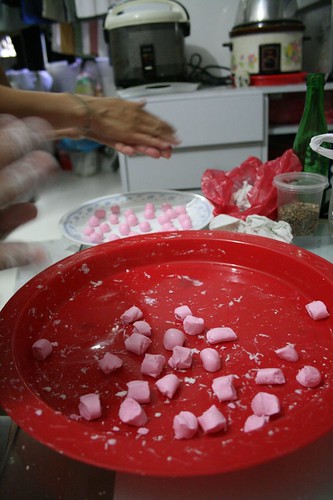
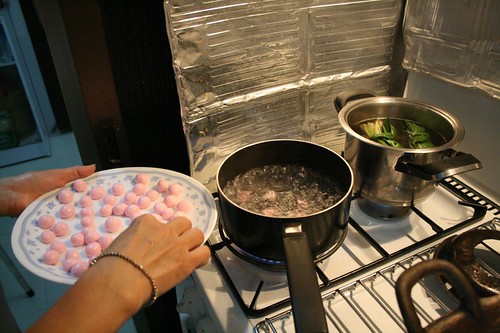
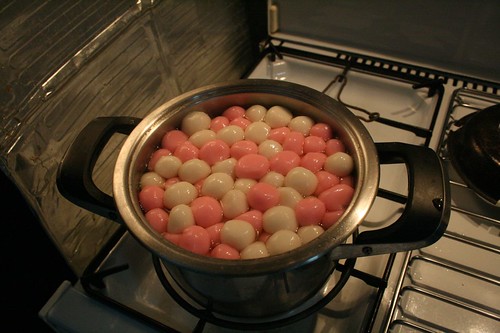
This is the day where we make Tang Yuan or glutinous rice dumplings. Some of you might be familiar with the Ahballing version with stuffings inside. But traditionally, just the "kosong" one will do. We make it from scratch and then boil it before soaking in brown sugar syrup.


According to my dad, the dumplings also serves as food offerings for ancestors and for the hungry lonely souls who do not have any family. Apparently they used to stick the dumpling on their doors for the passing ghouls.


See my flickr set for step by step pictorial instructions on the making of the dumpling! The only part I missed out is how to turn the flour to dough. Ack! The most important part actually. Hopefully there's still time to learn it in the next winter solstice.

Related Reads:
"For Winter Solstice, try some dumplings"
by Monica Eng, Chicago Tribune, 14 Dec 2006


Read full article here