Wednesday, April 05, 2006

Qing Ming Adventures Part I

Slept at 2am after completing my final essay of the semester *phew* and woke up at 6.30am to head out for Qing Ming "grave sweeping". Today is the actual day of Qing Ming.

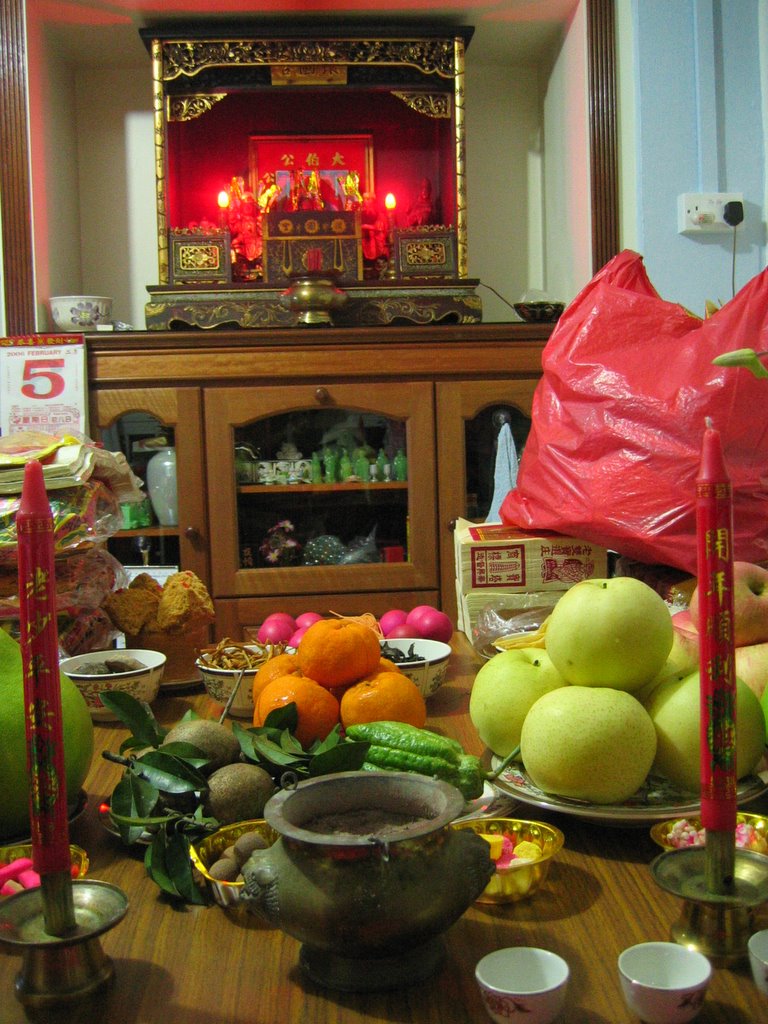
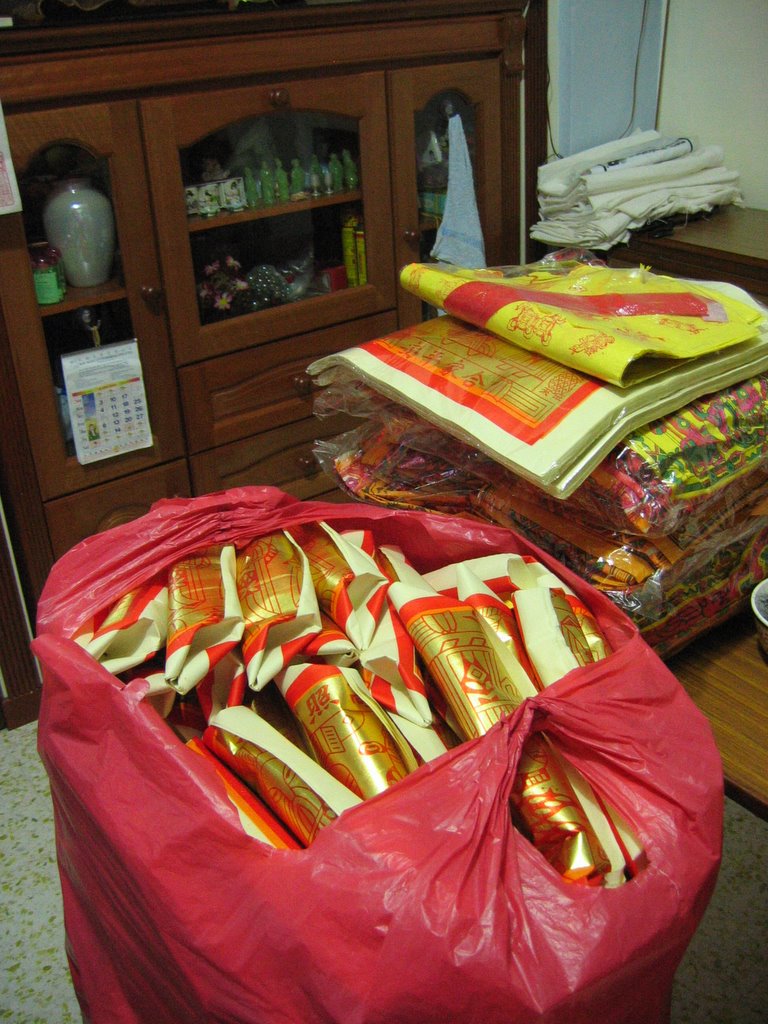
Since I'm such a klutz, I thought that today we were going to my maternal grandparents' grave. Instead, we went for my paternal grandparents side at Brights Hill and Bukit Timah's Bee Loh See. The systemization and commercialization of Qing Ming sickened me. At Bright Hill, we didn't have to bring anything, went to an aircon room, look at a piece of paper on the wall and paid out respect. All the food was prepared. Even burning of offers was done in a systematic way where a relay is formed from the people giving the offerings to the bangladeshi workers who then throws it in a swift motion straight into the big burning pit that is the end of your offering.

Nothing personal about the whole process at all. It was depressing. It totally undermines the entire purpose and meaning of Qing Ming. This corruption of our tradition with convenience speaks only of the generation's obligation to do something they do not necessary enjoy.

On the other hand, my maternal grandparents are at the crematorium in Mount Vernon where you are allowed to pay your respects and offer food and incense right in front of the urn-stone (since it's not exactly a tombstone). All of us chip in, chit chat, then proceed downstairs to burn the offerings together. After that we split the food and buy 4D of our grandparents "numbers" over breakfast. THAT is the true modern interpretation of Qing Ming. We do not need to be at a cemetery but the spirit lives on.

Photos to follow with Part II on April 16 when we head down to Mount Vernon for our second Qing Ming! Yay!


Read full article here

Monday, April 03, 2006

10 ways to change the world

"Your world. Your verdict: the small but beautiful ways that can help the fight to save the planet"
By Terry Kirby and Lucy Phillips
Published: 03 April 2006
The Independent Online Edition

PROPOSAL FOR CHANGE

Fit new buildings with solar panels or wind turbines
* PRO: Would reduce reliance on fossil fuels and provide renewable source of energy. Solar panels are benign and getting better at converting sunlight into electrical power.
* Against: Wind turbines would pose planning problems as well raising concerns over health and safety. Larger turbines already opposed on grounds of unsightliness and interference to birds. Solar and wind power may not be substitute for fossil fuels.

Label products according to their effect on climate:
* Pro: Would raise awareness among consumers about environmental impact of products. Could lead to companies competing in terms of being environmentally friendly.
* Against: Difficult to judge product's true impact on environment.

Force passengers to pay environmental cost of flying:
* Pro: Would have an impact on one of biggest sources of carbon dioxide emissions.
* Against: True environmental cost of flying difficult to assess and would be difficult to reach a consensus.

Public transport should be made cheaper:
* Pro: Minimises pollution in urban areas.
* Against: Trains are infrequent in certain areas.

Make energy- efficient light bulbs compulsory:
* Pro: Compact florescent light bulbs use up to 67 per cent less energy than traditional bulbs, and last 10 times longer. Incandescent bulbs waste 90 per cent of their energy as heat.
* Against: Currently CFLs cost between £5 and £8 each, compared with less than £1 for an ordinary incandescent bulb

Encourage people to work from home:
* Pro: Companies could reduce road congestion and greenhouse gas emissions, and help revive rural communities.
* Against: Companies would have to stump up to install computers and home offices for workers. Health and safety standards could be hard to enforce, and employees used to might find home-working an isolating experience.

Use the law to encourage recycling:
* Pro: Britain produces some 28.2 tonnes of household waste every year. Of this 87 per cent is incinerated or dumped in landfills, yet most household waste is suitable for either composting or recycling.
* Against: Collecting, sorting and recycling waste not cheap - councils with high recycling rates spend up to three times as much on waste collection as other local authorities.

Ban 4x4 cars from cities (SUV, MPV, etc.)
* Pro: Would reduce harmful emissions and would make roads safer for other motorists and pedestrians.
* Against: Motorists are still buying them - 187,000 4x4s were sold in Britain last year.

Reduce packaging on products
* Pros: Would drastically reduce the amount of waste we produce.
* Against: Recyclable wrapping can be more expensive, with costs passed on to buyers.

Ban patio heaters
* Pro: There are 750,000 in Britain producing 380,000 tons of greenhouse gases every year.
* Against: Ban would be difficult to police.


Read full article here

Wednesday, March 29, 2006

Fort Canning trees spared with new tunnelling method

Time is GMT + 8 hours
Posted: 29 March 2006 1732 hrs
By Sharon See, Channel NewsAsia

SINGAPORE : A new 350-metre long tunnel is being built right under Fort Canning Park.

The tunnel, set to be completed at the end of the year, will allow traffic travelling from Stamford Road to bypass two traffic junctions to get to Penang Road.

The Land Transport Authority says it is using a special mining method for the first time in Singapore.

With this method, which costs an additional S$2 million, the park will not be destroyed.

The traditional method of building tunnels includes digging up the entire area before covering it up again later.

This new method has helped to preserve 35 trees in the area, including a rare 50-year-old terap tree.

Said Choo Eng Geok, assistant manager (road construction), Road Development and Management Sub-Division, LTA, "We have actually one 50-year-old iconic tree which especially symbolises Fort Canning Park. And this is one of the methods that we can actually save the tree because the tunnel is very close to the tree." - CNA /ct

---
Monkey says:
I wonder how much jofen has a hand in this but this is really really good news! :)


Read full article here

Saturday, March 04, 2006

Lousy Louse-y Bugs


Anybody care to help identify these bugs that the whole of pulau hantu is infested with? Goes to show, a hammock when camping in tropical environment is indispensible!

More photos from linkan


Read full article here

Thursday, March 02, 2006

Bad Bat

Because duk keeps asking for it, here's the dead bat I talked about...


somebody identify it please?

Update: Duk says this is Malaysian fruit bat (Cynopterus brachyotis), not uncommon in Singapore. According to ecologyasia, this is also known as the Lesser Dog-faced Fruit Bat.


Read full article here

Revisiting Nepal

I'm writing a report on Government Involvement in Tourism Development: A case study of Nepal. While surfing on google earth (it does feel like i'm riding the waves of earths rotation), it feels almost like I'm back in Nepal. You know I do miss it quite a bit.


When people say Kathmandu lies in a valley, it's really hard to imagine it really looks quite incredible from space.


Read full article here

Friday, February 24, 2006

Damn Monkey Wrenchers

Monkey wrenchers be damn. I keep coming acoss one too many monkeywrenches today.

First I was at co-op when I came across the classic book the Monkey Wrench Gang. In fact, they are making it into a movie due to be out in 2007. That was when I first heard of the monkeywrench. I mean how could I not know what a monkey wrench is right? Could it ever be more relevant to me, the monkey?

Then a monkeywrench was thrown at me by yuene who not so discreetly winked at me when she used the term monkeywrench. Oh ha ha. 2 mentions in one day. Is that a sign?

XR who was with me and sharon today who puzzledly asked what monkeywrench is but I kept silent because I was then still struggling very hard to remember what it is! Embarrassing as that is, I had my memory refreshed by wikipedia.

For those uninitiated, the monkey wrench gang is the 70s equivalent of the ELF - Earth Liberation Front - a constant source of contention between me and W because there is no assuring him that I am no eco-terrorist.

The Monkey Wrench Gang was a novel by Edward Abbey about a group of people who goes and sabotage ecologically damaging development for the sake of the environment, otherwise known as eco-tage or eco-terrorism.

Now it's usually used to refer to actions that sabotages to the Establishment for nature or a good cause. Well yuene... I'm not very sure if unwed mother counts as being ecological but alright it is a good cause so we'll narrowly accept your answer. ding ding ding!

Honestly, I'm not a violent person. Call me chicken but having been stifled by the "peaceful" environment of Singapore, being involved in protests and marches scares me. My Thai teacher, an associate professor no less, very confidently told the whole class that she was actually going to fly back to Thailand to join in the protest against the prime minister a few weeks back but her mother stopped her. Gosh, I mean this is probably outrageous for Singapore standards. This is a woman probably in her 40s! Even Prof Savage, the upholder of all things proper and civilised, very gleefully tells us of their exploits in NUS in the 70s. God forbid if an NUS students be caught dead doing that these days. Wearing black in silent protest of the school fee hike is as daring as they come for our generation. Whatever of the young?

So, here I am, stifled, kia-si and the last thing somebody would describe as being extremist. But noooo, my future husband thinks I'm some environmental extremist who wants to join ELF just because I raved about supporting sustainable agriculture and hang out with the progressive types in Santa Barbara. Yeah, I won't tell your mama I'm a hippie... because I'm not!!!! Do I have to be a capitalist or a conformer of societally acceptable norms in order not to be a hippie? I am sorry but all it took to trigger the hippie association was the idea of communal kitchens. Because apparently that sounds too airy fairy to W and that means they are hippies disguised as egalitarian elites. bleh.

Whatever it is, I did concur with him but I definitely did not like being accused of being a hippie because I do aspire that lifestyle, TO SOME EXTENT. Everybody I was with was a supporter of that lifestyle but gosh, some drive, some even like speeding. So drum circles and swimming in lakes are hippie behavior. Does that mean I have to deprive myself of something I enjoy just not to be associated with hippies? And all this time, they're just afriad I'll end up smoking pot and leaving out of a trailer or on a 1000-yearsold redwood tree.

Why can't people have more faith in my kiasi-ness (read: cowardry). No amount of pretending to be a monkey would make me a monkey wrencher. I'm born chicken and will always be chicken!


Read full article here

Monkey Speak

Yesterday, a certain botak lao lang from KR surprised me with an unexpected msn message. The beast is now an entrepreneuring editor of uberture and asked if i wouldl like to write a column on environmental issues with peanuts for renumeration. Hesistant at first, the "captain planet" in me is now raring to go!

Came up with some ideas for articles on the way home today:

"Monkey Business"
About feeding monkeys in nature reserves, the idea of monkey reserves on an offshore island and other monkey business.

"Sex in the City"
About endangered animals, fragmentation of forest habitats, cities encroaching on forests, primary forests in singapore (botanic gardens, bt timah, dipterocaps in changi)

"Foreign Talents"
About releasing animals in the wild, and problem of invasive exotic species

"Pink Dolphins"
ACRES and sentosa pink dolphins, pink dolphins sighting off southern islands, marine life, reclamation, shipping line, removal of coral reefs, dugongs and other large marine mammals etc.

"A Straw Story"
The problems of straws, why do people insist on using straws, marine trash, use less plastics, etc.

"Swamp Thing"
role of mangroves, mandai, sungei buloh, places in singapore with swampy past, etc.

"Earth Day 2006"
April 22 earth day, origin, oil spills, celebrations worldwide and locally

"A little bird told me"
Tidbit stories about birds in singapore - koel/crow, kingfishers, mynas, strawheaded bulbul, jungle fowl, hornbill, plovers, heron, cattle egrets, barn owl, brahminy kite, himalayan griffon vulture

Wow that's enough for a whole year I think. lol. The ezine is fortnightly but mine may be a monthly column. Even still this is enough for about 4-5 months of fortnightly writings.


Read full article here

Thursday, February 09, 2006

St Andrew Kingfishers


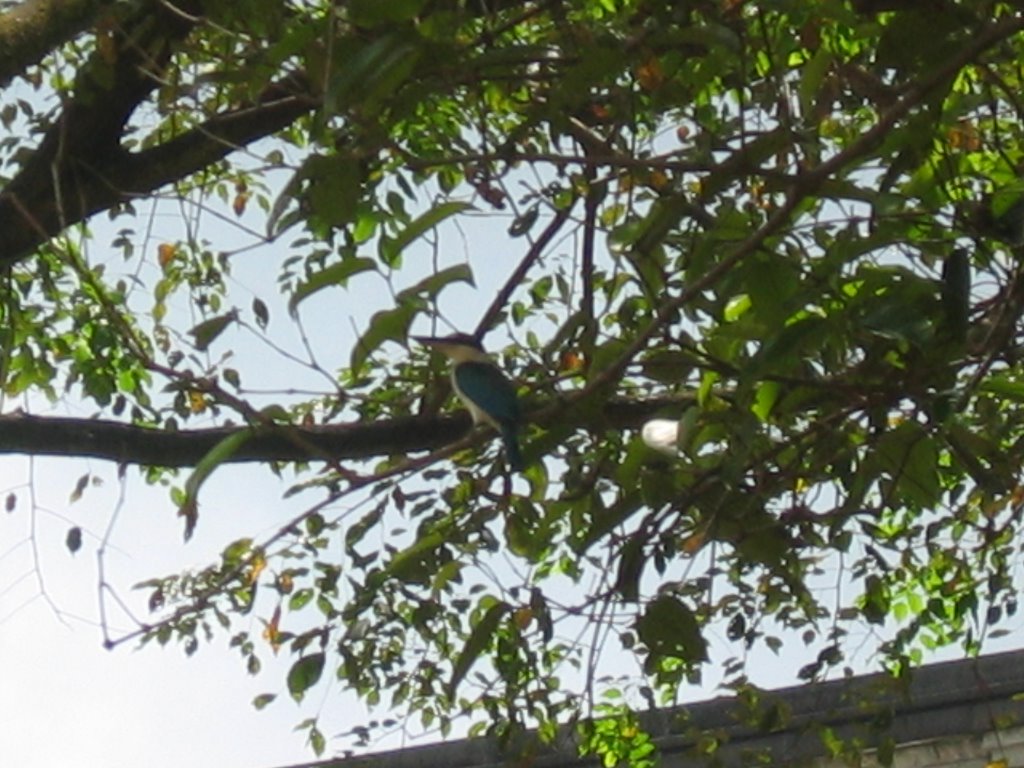
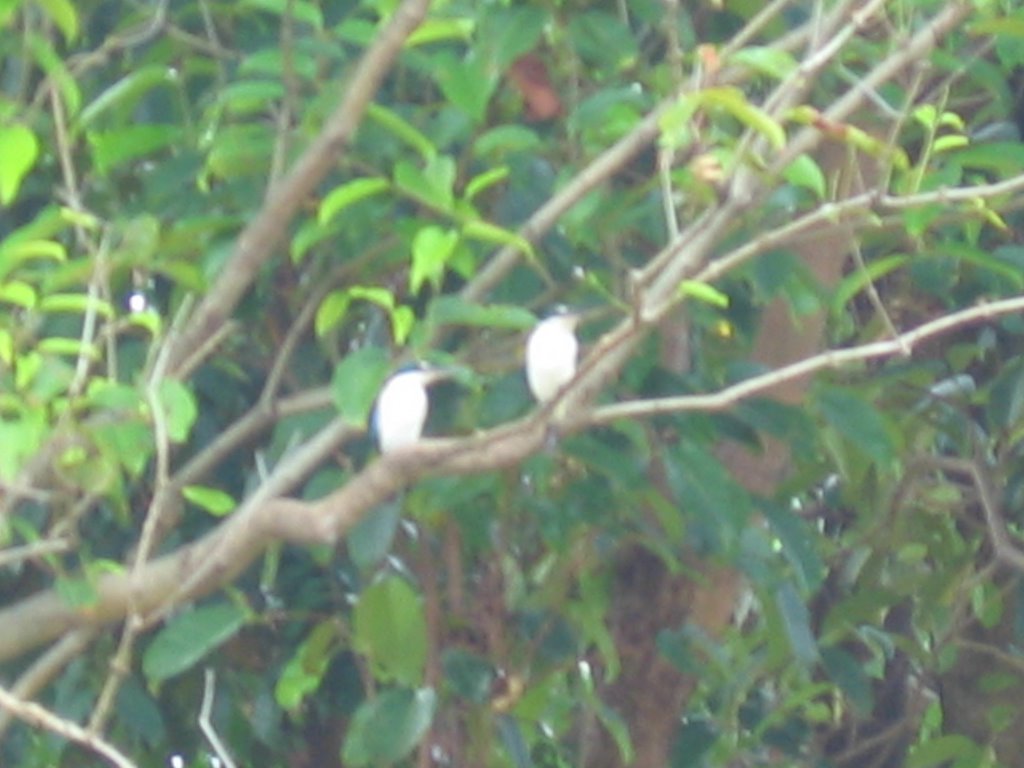
Collared Kingfisher of St Andrews Cathedral

No, thats not the species. I'm talking about the pair of Kingfishers I spotted at St Andrew Cathedral. In fact, after observing them over 3 weeks, I can safely say that they have made that tree, and that particular perch, home.

They are always there, always in the same position, with one on a higher branch and one on a lower one.

Well of course occasionally they fly away to other trees when they spy an annoying monkey sneaking not so discreetly up at them with a metal box.


NB: This is not the favourite branch I talked about. They resettled elsewhere coz of stalking monkey and falling rain.


Read full article here

Tuesday, February 07, 2006

Pai Ti Gong

Read: Worshipping the heavenly kingdom / emperor


On the 9th day of the Lunar New Year, it is the day to worship the heavenly kingdom and to pay tribute to the heavenly emperor. Preparations usually begins on the night of the 8th day for my family with loads of activity and furniture rearranging in the house. At 11pm on the 8th day, the tributes are set out on a table in front of the altar, facing the window (since the sky represents the heavens). The offerings of fruits and dried stuff usually has an intricate paper-cutting forming a word (I think it means longevity?) is placed on top of each and every offering. However, this year, due to death in the family, we did not place any paper-cuttings. *whisper: in fact we're not supposed to worship at all!*

At midnight, the first minutes of the 9th day, incense is offered and we troop off downstairs to burn the "paper money" and other gold and silver made from paper to the heavens.

tiangong 011

Usually there is also a pair of sugarcane that we tie to the window as pictured and as we go downstairs to burn the paper offerings, my dad will cut off the top end of the sugarcane and burn it as well.

This year, the sugarcane was black! My dad explained that this is the species that our hokkien ancestors originally grow in the fujian province.

While burning the sugarcane, I asked my mom the significance of offering the sugarcane. Previously I've only heard of banana leaf and trees being significant as they represent longeivity and eternal life as it's a plant that doesnt "die". My mom said she doesn't know. In fact, being teochew, she never heard of such practices before. My dad wasn't too sure why we do it but presumably only hokkiens do it and there are several speculations.

1) Our ancestors worked or owned sugar plantations and this is a tribute to their memory and our beginnings.

2) Since my dad only gave such a vague story about our ancestors, I decided to derive at my own speculation. When burning the sugarcane, large explosive pops were heard from the fire that sounds suspiciously like firecrackers! Turned out that sugarcane when burnt create sounds like the firecrackers and could be a reason for it being offered and burnt in worship. Loud noises are meant to scare the evil and bad away. It could also be a post-firecracker-banning practice in Singapore, to offer an alternative substitute to actual firecrackers.

tiangong 005 tiangong 008

Either way, it sounds reasonable to me. Does anybody have other possible stories about sugarcanes being offered to the Ti Gong? Then again, with traditional practices and rituals being lost in our modern society, I doubt anybody would know better than my parents cept for those who are their elders.

Just today in the news, it's been reported that less families now have altars in their family and temples are seeing a 2 or 3 times increase in the number of people going to temple to offer tributes and to worship the heavenly emperor on the 9th day of the lunar new year. Usually a ritual meant to be done from night to day, people are going as and when it suits their work schedule and when the temple is open for the public - which is usually the day time. They also don't have to spend hours busying in the kitchen and preparing items as it would be simplified and provided for in the temple. But, to me, that loses all the meaning and specialness of this day... or at least, the meaning this day holds for me anyway. It's always been a rare day of activity for my family, and a good reason to stay up late.

Update: Chinatownboy wrote about pai ti gong too!!!!!!! I was going to go look up his blog to share with him my story and i had a strong feeling he will write about this very important event. Afterall, I knew him through interest in chinese diaspora taoist practices in singapore. whee! (yes i have odd and diverse interests) Note to victor: if you are reading this, scroll down and see my "human day" (ren ri) post :D

According to Chinatownboy:

A pair of sugar canes was and is still a must. According to stories heard, it was said once the Hokkien were being attacked (not sure if they were the mongols or bandits) and they went to hide in the sugar cane field. The sugar cane saved their lived. And so, when they came out alive, in gratitude the prayed to Ti Kong with the sugar canes, probably reminding them of how their lives were saved.


Read full article here

Saturday, February 04, 2006

Happy Human Day

The 7th Day of the New Year on the lunar calendar is "Human Day" or ren ri.

I am vaguely remembering that it is the day humans are created or something because today is the birthday of humans (ren de sheng ri). Does anybody know any differently? Please correct me.

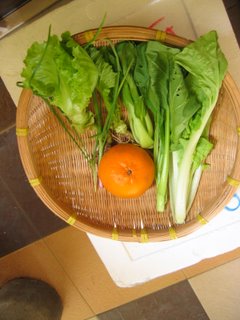
On this day, we have to eat a dish of 7 vegetables. Yes, that's 7 vegetables cooked as a mixed veggie dish.

What does that reveal about the asian society and culture?


1. Plant diversity is very high.
The diversity of vegetables and edible food plants must be so high that it was easily accessible to the peasants and commonfolks of China and possibly east and southeast asia.


2. Food diversity is very high.
Not only were the variety of vegetables in great diverse amounts, it also shows that they were consuming a great diversity of plants and domesticating, planting these food crops that we might not be consuming today. If you go to your kitchen right now and look in your refrigerator, how many different types of vegetables can you find? Or even anything green?! Green eggs not counted. Honestly, seven is a lot. But it must not even be a lot if it's supposed to be a comfortable number for them to handle back then. Perhaps there are vegetables that they were consuming then that we have now lost. In the village in Thailand, I observed so much more food diversity in terms of the type of plants they consume that I was amazed at where they even think of eating these things!


3. Cash crops are taking over the world.
If we city folks are thinking "wow 7 vegetables in one is a lot... who would have think of that", that's because the commercialized cash crops are taking over our world. It is wiping out food diversity and local knowledge, knowledge of our ancestors in terms of giving variety in our diet. Why is variety important? On an anthropocentric level, it provides diversity of nutrients for our body that a single diet of wheat will not. On an ecocentric level, having food diversity means that there needs to be crop diversity - no monoculture. Subsistence farmers plant perhaps 10 crops in the same area of land as compared to the 1 crop by a monoculturist. This ensures that the soil nutrient doesnt get depleted. Also, it ensures the survival and continued existence of 10 different species of plants as opposed to the 1 cash crop which most of the time, we CANNOT eat. Can you imagine eating oil palm?

Even then, what's up with brocolli?! Do you know about more than 5 of the vegetables we eat regularly and can easily find in our supermarket are all really just the yellow mustard plant that has been bred selectively to become different "vegetables" but they are all just the mustard plant, ONLY! If you think you are eating different types of vegetables when you eat brocolli, cabbage, etc... no really... it's just one plant. NO DIVERSITY!


4. Neo-colonialists are amongst us.
Who owns these monocultures? Big corporations.
Who wipe out the subsitence farmer and introduce the limited variety of vegetables and food in our markets? Big corporations.
Where are big corporations from? The west.
Ok this is a really simplified way of looking at this but if you think about it hard enough, the west are dominating our food supply even if the farmers are in the east or south. Globalization of food supply is wiping out local subsistency. We know Singapore cannot support our own food supply because we are small but what about big agricultural countries like Thailand, Malaysia or Indonesia. Why can't they support their own population's food demands despite being an agricultural country? Because they only grow cash crop that is being exported out of the country for foreign exchange. So people remain poor, hungry and forced to eat whatever the neo-colonialists dominate our market with. Why do you think US has a whole entire region called the "corn belt". Because whole entire states are just growing monocultures of corn and wheat and dumped on countries that do not otherwise subsist on those things. Where do u think your cornflakes come from?


5. Our ancestors have very bad taste in food.
Do you know how icky 7 vegetables mishmash together in one bowl taste like?! Pfft! They couldn't even have the decency to cook them seperately... or maybe it's just my dad. hehehe


Read full article here

Tuesday, January 31, 2006

I want one too


My Sunshine

In Garrett Hardin's own words, from his famous paper "Tragedy of the Commons":

"People vary. Confronted with appeals to limit breeding, some people will undoubtedly respond to the plea more than others. Those who have more children will produce a larger fraction of the next generation that those with more susceptible consciences. The difference will be accentuated, generation by generation.

In C.G. Darwin's (Charles' grandson) words: "It may well be that it would take hundreds of generation for the progenitive instinct to develop in this way, but if it should do so, nature would have taken her revenge, and the variety Homo contraciptiens would become extinct and would be replaced by the variety Homo progenitivus

... The argument has here been stated in the context of the population problem, but it applies equally well to any instance in which society appeals to an individual exploiting a commons to restrain himself for the general good - by means of his conscience. To make such an appeal is to set up a selective system that works towards the elimination of conscience from the race".

- From the paragraph "Conscience is Self-Eliminating"

My ticking biological clock aside, seriously, this particular quote has really set me thinking. I have always been of the belief that as the knowing ones, we should set a good example.

In JC, I thought that the best way to save the world is to wipe out all of mankind. Then after the first week of class in NUS, I found out why people even bother "saving the planet" - it's really because we the humans need it and want to keep the environment as we know it. Recently, I have been firm that we could create a snowball effect if we each play our own part and stop the consumption and thus supply of destructive products such as sharks fin and virgin paper by stopping our own consumption. Similarly, how could we continue to populate this overcrowded planet when we know how depleted it already is. Some would say we should thus play our own part and stop contributing to our over-population.

Having read Hardin, I now believe that having a guilty conscience from contributing to the pressures on earth's carrying capacity is definitely better than letting the evil, selfish, self-centered, egocentric, souless, conscienceless, capitalist and developement-happy Homo progenitivus take over our planet!

Let us all go forth and procreate NOW!*

* The above offer is only available to all environmentally conscientious souls who may otherwise be held back by a guilty conscience as previously mentioned above.


Read full article here

Friday, January 20, 2006

The Birding Monkey

Monkey has never been much of a birder. In fact, I was a serious disappointment at Fraser's Hill where all the bio grads were glued to binoculars and ooo-ing and aaa-ing at the great diversity of birds there.

However, being an avid reader of Prof Wee's bird ecology blog, I have begin to learn by osmosis and somehow, somewhere, I must have caught the bird flu... the birding flu that is!

Today when azurev and I were slacking having lunch at the grounds of St Andrews Cathedral, enjoying the vast greenery in the heart of the city, I suddenly saw a flash of azure.

No azurev didn't flash me but I saw azure wings reflecting in the sun and landed on a branch about 40m away from where we were seated - in front of the church. It had beautiful clear bright blue wings and pure white chest.

The first thought that came to mind was that WOW kingfisher! But what the heck are kingfishers doing in the heart of town?

I quickly prod azurev and after trying very hard and short of doing a printscreen and drawing an arrow on the bird, she finally spotted the bird. Just then, another of white-breasted bird landed 0.5m away from the first one, on the next branch. Wow, must be a couple. However, I cannot see the wings of the 2nd bird so I decided to walk forward to check them out.

It's hard to sneak up on 2 birds when there's no camoflague in sight. It's like a giraffe stalking a deer in the clear open grassland, without nothing to hide behind.

I walked relatively slowly and approached the tree on the other end of the field. (we were on opposite ends of the church ground or "field" if you prefer.) As I got about 10-15m away from the tree, I finally saw the blue wings of the 2nd bird to confirm that they are indeed a couple.

However, just then, the first bird and I made eye contact and he started to make the most raucous call ever! Indeed, I shall call it a squawk. It was so loud and immediately I know that he's trying to warn me away from his tree. Perhaps his nest is there?

Once he started squawking, I turned back and looked at azurev excitedly because I had made contact with the bird, despite a not-so-friendly one. I can tell from her expression that she's heard the squawking too which goes to show how loud it was. She described it as being as loud as a "fog horn".

Sadly, both of us did not have a camera on us, not even a camera phone. It's times like this that you wish you subscribed to the technological fervor.

Oh well, when I came back to the office and searched around online, the only bird I can find that looked even slightly like it was the white collared kingfisher (Halcyon chloris).


So far, all mention of this species I found online are of sightings at Kranji or Sungei Buloh. What was it doing at St Andrews Cathedral? Did it really have a nest on that tree? Or did it fly from the marina bay area and was stopping for a rest?

I did find a picture of the collared Kingfisher at the botanic gardens though.


In Ria's Mangrove and wetland wildlife at Sungei Buloh Wetlands Reserve, it writes this about the White Collared Kingfisher:

The Collared Kingfisher is the most common Kingfisher in Singapore.

Collared Kingfishers are particularly aggressive. Not only towards their own kind, but also towards other Kingfisher species. This could be another reason for the widespread presence. The decline in the White-throated Kingfishers might also be due to the spread of the Collared.

They are also aggressive towards other birds such as mynas; vigorously driving off these birds from their feeding grounds, particularly during breeding season. They may even drive off landbound creatures.

The Collared Kingfisher is not considered at risk in Singapore. In the past, they were mostly found along the coasts and mangroves. But they have moved inland to hunt along freshwater wetlands, cultivated lands, gardens and parks. They usually avoid forests.

That surely explains why it was found in the garden of St Andrew Cathedral then and its agressive behavior towards me. I'm guessing now that the first bird is a male because mated males are supposed to be more blue than the females which is a lil more greenish.

I'll definitely go back again with a camera, just hope that it's still there for me when I go prepared!


Read full article here

Sunday, January 15, 2006

Palgrave Environmental Reader

Few days ago I mentioned the books on my monkey shelf. Well, it just so happened that I borrowed this book Palgrave Environmental Reader out of pure... boredom and good intentions (like making myself be hardworking and enrich myself beyond the classroom).

Then on Thursday during Savage's lecture, he was going on and on about how university students dont read original texts of landmark literature anymore, like Garrett Hardin's Tragedy of the Commons.

Of course I've heard of Tragedy of the Commons. In fact, Hardin was a professor at UCSB for 30 years. I've used the concept many times. Still, Savage was right. I never actually read the original article. He also recommended reading Glacken's Traces on the Rhodian Shore which I must say I was fortunate enough to have even heard of Glacken by the pure coincidence that my nature, science and religion class had a reading list of very well known works. Now thinking back, both Savage and Proctor both did their PhD in UC Berkeley. That's probably why they are all harping on Glacken. Apparently Glacken was Savage's PhD supervisor. Gosh!

Just on a slight digress, after Savage's class, I can almost totally understand now (if I can actually remember my then-epiphany) why Proctor is considered a geographer since his preoccupation is mainly with nature science and religion. Something along the line of every religion has a perspective of the space/environment that will have subsequent impact on it. Well that pretty much sums up Proctor's lecture which I got an A+ for but suddenly... my aging memory with dozens of competitive uses threatening to blind me has caused me to have a sudden mental blackout. Bah.

Back to Palgrave.

Well, so yesterday I decided to be hardworking and was happily flipping the book and guess what I saw?

Garrett Hardin's original text of Tragedy of the Commons published December 13, 1968 in the journal Science, Vol 162, No 3859.

So I spent the whole of yesterday and a bit of today reading it and I've decided to reproduce sections on the blog every other day. It's a really good read and it's easy to digest. I want to ingrain it in my memory.

There are also other interesting and landmark articles on the environment such as Pinchot (the father of the US Forest and Wildlife Services), John Muir (the father of the alternative movement of FWS, the US National Parks Services - though Muir started out working for Pinchot), Rachel Carson (the person who wrote Silent Springs and shed light on DDT and agent orange), EO Wilson, and to go back a few centuries, Palgrave also included Emerson and Thoreau. The best part is, they also include famous legal acts and bills such as the actual text of the Wilderness Act and the Kyoto Protocol.

I'm sad to say though that this book focuses only on the US environmental growth, change and evolution over the last 3 centuries. It's not altogether comprehensive but it is a start.

As the editors, Daniel Payne and Richard Newman, writes:

The US has gone from "first generation environmental reform concerned primarily with land use issues such as resource conservation, wilderness preservation and the establishment of national parks and monuments" to "second-generation environmental issues, such as nuclear war, disposal of nuclear wastes, chemical contamination, global warming, biodiversity and so on, [that] have superceded land use politices as the primary focus of many environmentalists".
Reading that, I wonder where Singapore is - First generation or Second generation? On one hand, we have on surface levels, dealt really well with second generation issues which are mainly a focus on brown and gray issues but we have failed miserably and has never passed the test of solving first generation issues while the US has at least tackled it. Singapore is like a kid who failed primary school but jumped on to secondary school and found that it does well and try to present to the world the appearance of an environmental hub of asia by its clean and green branding. However, that will not stop people from criticizing that it has failed miserably at its primary level - that of pure and simple biodiversity conservation.


Read full article here

Ignoramus politicae


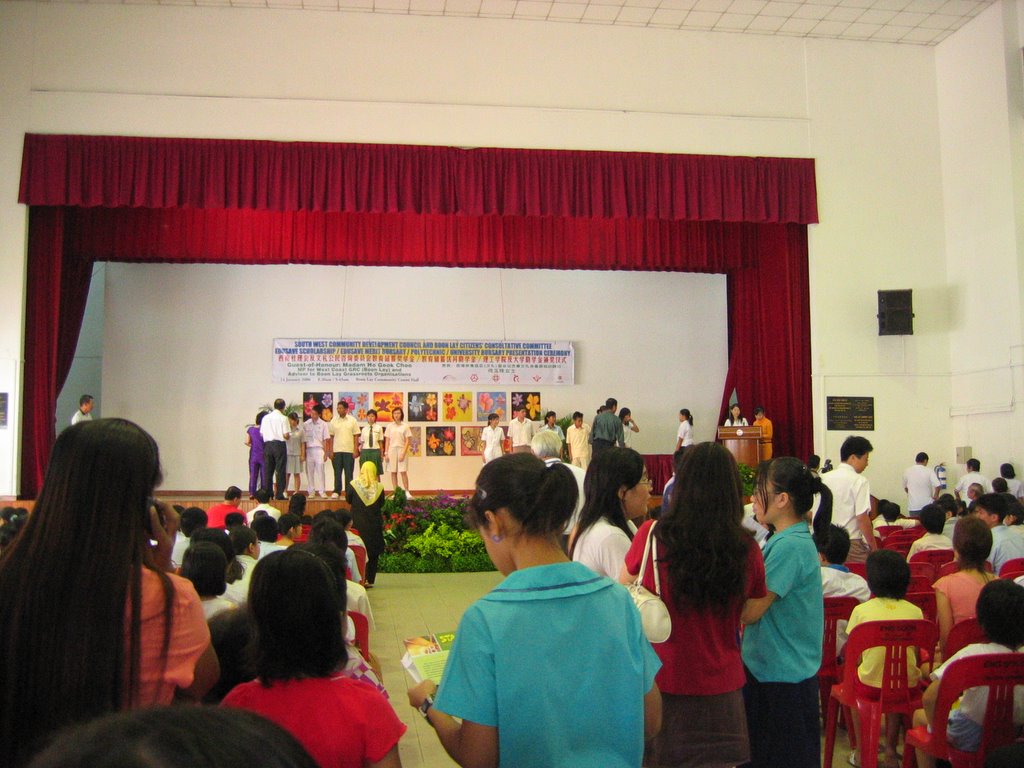
The nightmarishnostalgic reminders of school uniforms, assembly halls and the boon lay community center where I was collecting the same thing those lil peep squeaks are today.

Why is it that the first thing MP Ho Geok Choo ask me when she hears I'm studying geography is that "are you going to be a teacher?"

In my environmental politics class, my lecturer said that politicians are mostly lawyers, political science types or economists. Seldom are they scientists. And surely they are too busy to be kept up to date on issue. Apparently it keeps them rather shallow and ignorant too.

Of all the people from the university category who were award the bursary today, I was the only one she did not invite to join the Boon Lay Youth Club in her lil chit chat on stage when she hands over my "stipend". I was going to scoff at her if she did anyway. Maybe she read my mind. Still, I'm offended. Bah! I'll have her know my sister was in the Boon Lay Youth Club! PFFT!

I'm so offended that ms reverse psychology has decided to win the freaking SYA award just to rub it in mdm ho's face. Maybe better yet I'll win greenwave too. One thing for sure, I'm definitely going to see what Ms Irene Ng has to say. I mean if this is the standards of female politicians in Singapore? Dear lord, it leaves much to be desired for.


Read full article here

Friday, January 13, 2006

Nanotech, Friend or Fiend?

The other day I was trying to tell the divinebovine how Nanotech is bad but then after a year away from progressive people rubbing off on me and back in development and technology deterministic red dot on the map, I was at a lost for words.

If I could persuade Maral in SB that Nanotech is bad, then I'm sure I have had been pretty persuasive.

So here's an article from Associated Press that would do the convincing for me.

Came across it just now when I was gathering environmental news for Ocean Futures Society. (Yes I'm still an intern there O_O")

Study Raises Concerns about Nanotech
Associated Press, 11 January 2006

(I'm still digging around for more articles. I'm not just concerned about human health but just undermining general safety and weapons and what not)

Nano Hazards: Exposure to minute particles harms lungs, circulatory system
Science News Online, 19 March 2005

What About Nanotech's Potential Danger? [PDF]
Techcomm Journal, April-May 2005
View as HTML


Read full article here

Sunday, January 08, 2006

Specialist Monkey

Is it my training or is it just me?

People always say that NUS general degree produces nothing but generalists who knows nothing. But why do "geographical" stuff keep jumping out and hitting me in the face? Maybe I simply aspire to be like Prof Wong who told us that if you want to be an expert in your field, you must be able to go out there and be able to assess the environment with one look and be able to sum up the problem. Of course he also said that his ability came with 30 years of field experience. Maybe I would like 30 years of field experience too. In fact, I was really impressed when I saw Prof Wong's Honors Thesis on the physical environment of Singapore in 1966(?). How incredible. I hope I would be able to go through most of the geog thesis ever written in the history of geography department.

Why do I bring this up?

Yesterday on our way to the hairdresser, when we drove by this slope near my Aunt's house, near the PIE exit, something suddenly caught my eye. A relatively large area of the slope had suffered from mass movement, if I'm not wrong, it's either a rotational slip or a slump. It looks exactly like the diagrams we see in textbooks all the time.


Slumps are supposed to be lubricated by groundwater seepage and this was precisely what occured if I'm not wrong. There was a spring gush of water coming out from the exposed slopeface. I suspected it was the effusive permeation due to the excessive rainfall but my parents think that it could be a water pipe leaking since we don't really have real groundwater flow in singapore (hah! so they think).

I can't verify until I go and take a picture of it soon, as soon as the rain stops of course. *cough* But thinking rain made me think of something totally different that happened around this time last year.

This time last year, we were having a dry spell or drought and even resulted in quite a bit of bush fire!

Looking back at last year's blog posts, Straits Times reported "256 bush fires in 40 days" on 13 February. Understandably, that is still a month away and this almost monsoon like wet season might be over. Still, this really smells like climatic imbalance to me, does it not?


Aftermath of Bush fire in february 2005

On one hand, we have floods and water pipes bursting in holland village with overflowing water every where but last year this time we were dryer than summertime chapparel grassland. Or maybe the fengshui experts will suggest an elemental imbalance. *snigger*


2006 Anthropogenic Flood at holland avenue
Photo courtesy of the otter.

Oftentimes, it is occassion like this where most of slope failures and disasters occur. People in temperate countries get plagued by the flu and in California, the rain (yes it rains in CA!) results not only in floods but massive landslides which killed many people (like La Conchita last year). Trains get stopped and tracks get washed off. Multiple car accidents happened as highways get too dangerous. Even in Singapore, as above, the landslides do occur too! Just pray that nothing gets worse than this.


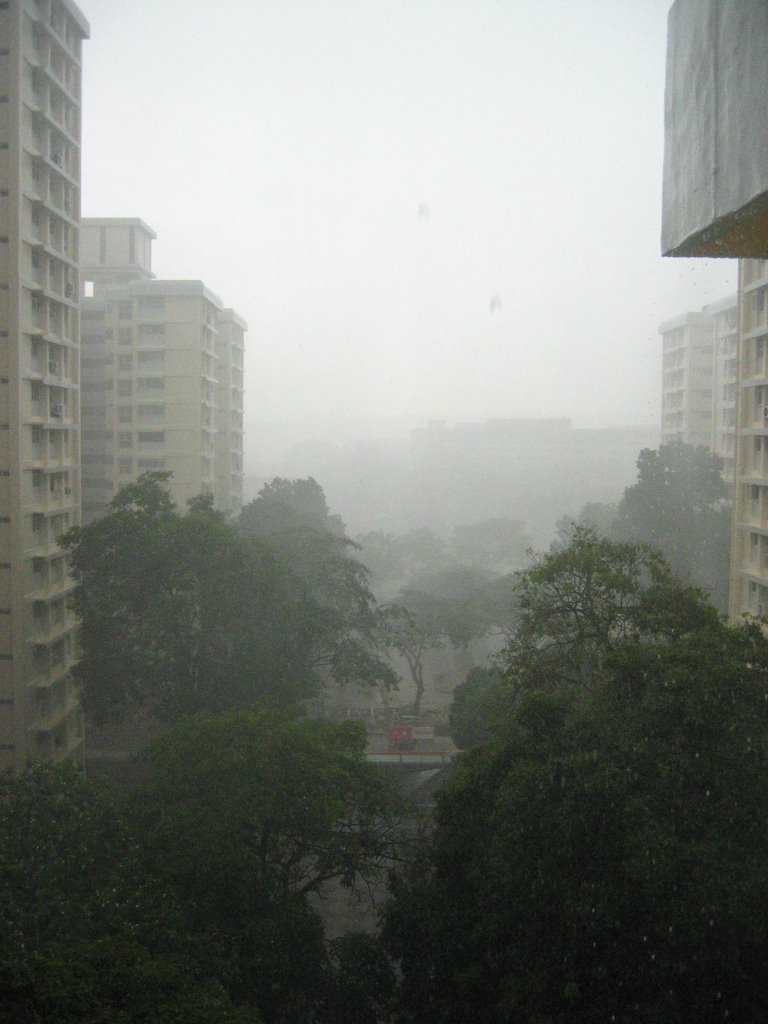
The infinite rain looked as if the sky opened up and dumped the south china sea on us.


Read full article here

Saturday, January 07, 2006

On Monkey's bookshelf


Indigenous people and migrants of northeen papua indonesia
by Howard, Michael C. & Naffi Sanggenafa (Editors)
Published: 2005, Thailand, 1st Edition
ISBN: 9744800658
[Borrowed: NUS Libraries]
Status: Awaiting my furry touch


The Palgrave Environmental Reader
Edited by Richard S. Newman and Daniel G. Payne
From Palgrave Macmillan
Pub date: Nov 2005
[Borrowed: NUS Libraries]
Status: Awaiting my furry touch


So Long, and Thanks for All the Fish
by Douglas Adams
[Borrowed: National Libraries]
Status: In reading. Sitting in my bag now. Better than Mostly Harmless. I like the story of fenchurch. Sounds like a mouse's name.


Life, the Universe and Everything
by Douglas Adams
[Borrowed: National Libraries]
Status: Awaiting my furry touch


Mostly Harmless
by Douglas Adams
[Borrowed: National Libraries]
Status: Borrowed and returned. Didn't finish reading. Was too boring.


Read full article here

Thursday, December 15, 2005

LTA saves a tree!

Today on the Channel 8 news (15 Dec 2005), there are reports that LTA has changed the course of a road (Braddell road perhaps?! Bu Lai De Ling?) in order to save a tree!

The tree now stands between 2 lanes of the same direction!

Immediately I thought of Jo-fen who is now the first pioneer environmental engineer that LTA ever hired. She must have been working hard. *proud of her*

Of course I tried hunting for the article online but I couldn't find it on CNA! Then I tried channel 8's news page but they rather have a report on the blind enjoying art than a tree being saved. Bah!

Most unfortunate of all, drivers and the public were complaining that saving the tree and splitting the road is actually a road hazard and advises LTA to draw a balance between conservation and public safety!

WTF! I won't see them saying that LTA is unbalanced when they go outright bulldozing the area and saying they should pay more attention to conservation than convenience.

The tree is an hard wood tree that is big, old and well formed. It is so big that you can see it for miles away. It's not at the end of a blind spot or turn. Why would any drivers who are not drunk and paying attention to the road miss the tree?! If they can actually manage to drive their way into the tree, they really deserve a prize!

A prize for the most kok eye bugger in Singapore that is!

Update (11.42pm): I've just emailed CNA chinese edition asking them to either put this article on their website or email it to me since currently it cannot be found. Hopefully somebody replied *cross fingers*

----
Update @ May 3, 2006: This is the Angsana tree that you can see as your drive by Braddell road.


Read full article here

Friday, December 02, 2005

Where would you hide?


In the bushes of course!


Today was a really long day from my last examination this morning, then went to help Andrew move a tonne of luggage to Fullerton, checked out the cool view, met Wai at cityhall while having lunch at my favourite japanese restaurant. Then we went to Bugis, found out they only show 3 movies and decided to go Arab Street to buy sarong for Andrew's dad. On the way there we found the abandoned toilet bowl!

Who knows that that is only a precursor of what is to come!

When we arrived at Tampines to set up the Toddycats booth at the Volunteer Fair, we found the World Toilet Organization (WTO) having a booth there right amongst the rest of the environmental group! This would really tickle the duck's feather since he has a feature on poop condition around the world in his blog.

Those lil cut outs are actual illustrated figures of the founder of WTO - Jack Sim! I've seen him several times at various forums such as the Singapore Green Plan public forum and the UN Global Compact Singapore network launch.

I do hope to be introduced to him one day. I've really heard so much about him. He's also the guy who tipped the archaeologists off to the possible existence of the buried Tanjong Katong Fort!

Of course we weren't there just to check out other people's privy. We were hard at work putting up posters amidst overexcited toddycats. It was quite a... spectacle, or should I say, cacophony.


Still, at the end of the day, Toddycats get the work done and always have fun! WHEE!


Read full article here

Wednesday, November 23, 2005

Word of the month

Slaughtering Trees:

(v) The act of printing a whole semester worth of lecture notes and other readings days before the final exam in an attempt to make a last minute dash for the finish line or for the purpose of accomodating easy reference in open book exams and in the process, consume several trees worth of paper.

e.g.: I'm going to go slaughter trees in the library on Friday.

On other news:

  • The remote sensing exam was pleasantly uplifting.
  • My application for the NUS Coop Book Grant was unsuccessful.
  • I need to make money. How? SDT? OAR? Tution? Should I try for an internship with URA? I need a job. Everything is so up in the air right now. Sigh. Tomorrow look up the newspaper classifieds.
  • Starhub gave me a $200 voucher for a new phone provided I open a new line. Wonder if its worth it. Must as W.
  • I am cultivating a spot of fungi on the withering bouquet.
  • Don't know what's going on with Toddycats or what I am doing. Dun know. Anything.
  • Reminder: alexander hospital is moving, go dentist soon.
  • I've been posting on Pulau Ubin Stories. Should be doing more of this. Research research research!
  • Got my other intern with OFS to be posting actively on ENA from December on.

    Theres just too much on my mind. *miserable*

    Why do I feel that the end of the exams is going to come too suddenly and I'll be stuck with nothing to do, or caught offguard.


    Read full article here

  • Tuesday, October 11, 2005

    Alas Now I am Likened with Cpt Planet

    S'pore's Captain Planet
    Greenie high-flyer to attend UN Forum
    WHEN she was a child, she wanted to be like Captain Planet, a cartoon super hero who fights to save the planet from environmental problems.
    By Teh Jen Lee

    11 October 2005
    WHEN she was a child, she wanted to be like Captain Planet, a cartoon super hero who fights to save the planet from environmental problems.

    Of course, she doesn't have his super powers, but uses her talents to make an impact on Mother Earth.

    Ms Tan Peng Ting, 24, (left) will attend the first Eco-Minds Youth Forum on sustainable development in Manila at the end of this month.

    This is not the first time she's representing Singapore in such a programme. Last November, she was chosen as a Bayer Young Environmental Envoy for her contributions in promoting the preservation of Pulau Ubin.

    She had set up an online information archive containing personal stories, history and articles about Ubin. She also helped organise Pedal Ubin, a unique guided-tour of the island on bicycle.

    Together with three other Singaporeans, she won a week-long trip to Germany last November, with all expenses paid by Bayer.

    Her older sister, Ms Tan Peng Ling, 32, recalled how Ms Tan loved Captain Planet when she was in Primary Five.

    She said: 'I got her an activity book and mask because I knew she wanted to be Captain Planet when she grew up.'

    The younger Ms Tan still has the mask.

    This year, she impressed the judges again with other environmental programmes.

    The third-year Geography undergraduate from NUS set up a local 'whistle-blower' group with a difference.

    The two-month-old group is called Toddycats Engage and they are open to the 100-plus volunteers with the Raffles Museum of Biodiversity Research.

    They meet once a month to give feedback and to voice concerns over issues like trees being cut down during estate upgradings and air-conditioning being excessively cold.

    Said Ms Tan Peng Ting: 'We write letters on the spot. It's an avenue for people to express themselves. We hope to build a civil society by giving feedback regularly.

    'We don't just point out the bad, we applaud the good. When people are affirmed, they are more willing to listen to future feedback.'

    --------------------------------------------------------------------------------

    ECO-MINDS FORUM

    ECO-MINDS Forum is a joint youth environmental education programme of the United Nations Environment Program and Bayer.

    Delegates from nine Asia Pacific countries, selected from fields such as natural sciences, engineering and commerce will team up to discuss problems caused by development.


    Read full article here

    Saturday, September 17, 2005

    Kinda busy

    Went to the UN Global Compact Singapore Network launch today and took lots of pictures of big shots like Lim Swee Say and Claire Chiang. I am really full of admiration for Claire Chiang now. She is really passionate about sustainability and I guess Banyan tree is really quite good despite their exorbitant prices. Her push for Corporate Social Responsibility with this Global Compact is basically to get the business sector to be more responsible global citizens. It's like fair trade but with more elements such as human, labor, environment and anti-corruption principles. But it also try to make everybody look good because each member is only needed to accomplish juat at least one of the principles and as a collective they appear more successful. Ah well... saw Jack Sim of World Toilet Organization again though. *grin* He is so far a regular in the forums I attend.

    Was terribly underdressed but surely felt better the minute I left those suit and ties. Walked through change alley and saw Raffles Hotel Mooncake being sold! After being told by Mrsduck that they had macademia snowskin mooncake, I wanted to investigate. Walking closer, I saw YELLOW boxes being sold. That is from last year! Horror upon horror, I took a picture of the evidence and left. *sigh* Then I heard from another friend today that they DO have macademia and what they didn't was the champagne truffle (which i have!) Regardless, all this only proved that the sales lady who told me they NEVER had macademia snowskin is lying through her teeth.


    Incriminating Evidence


    Read full article here

    Wednesday, July 27, 2005

    Environmental News Archive

    http://environmentalnews.blogspot.com/

    As the environmental news intern for Ocean Futures Society, my job is to compile news articles from numerous sources to educate and update the OFS staff, members and interested individuals.

    Thus, in the spirit of my job, I started the Environmental News Archive for all interested individuals in Singapore to enjoy a summary of weekly environmental news and any other interesting articles I come across in my job.

    In fact, this website also has RSS feed for a change. I do not see damaging effects at the moment since comments are disabled.

    RSS it!


    Read full article here

    Sunday, July 17, 2005

    Importance of a Sensei

    For a while now I have been hearing about the Yale School of Forestry and Environmental Studies.

    However, as many graduate students have told me, the importance lies not in the school but on who your advisor is. Yes, the importance of the age old concept of a "sensei". The master of whom I shall be apprentice to. The wizard of which I will be mickey mouse... O_O"

    Honestly, today is the first time I looked into the program at Yale and damn I am really impressed by the following three faculty.

    Prof William R. Burch, Jr
    Professor of Natural Resource Management, and Social and POlicy Studies.
    His work on wildland recreation behavior was among the earliest, and it has expanded to include parks, biosphere reserves, and ecotourist regions in rural and urban areas in Asia, South America, and Europe, as well as in North America.
    He conducted some of the original work on community/social forestry systems, which continues with work in Nepal, Thailand, China, and inner cities of the United States. Community forestry strategies for urban neighborhoods have been applied since 1989.
    Another area of research and application has been in developing a unified ecosystem management approach that fully includes human behavioral variables.

    --> He does qualify some of my interests. Ecotourism, community forestry (but less indigenous knowledge) and a holistic management system that includes humans on top of biophysical concerns. He does work in Asia which is important.

    Prof Carol Carpenter
    Lecturer in Natural Resource Social Science and Anthropology.
    Dr. Carpenter’s teaching and research interests focus on theories of social ecology, social aspects of sustainable development and conservation, and gender in agrarian and ecological systems. She spent four years in Indonesia engaged in household and community-level research on rituals and social networks. Her current interests involve the invisibility of women’s economic activities in agrarian households and the implications of this invisibility for sustainable development.
    --> All that "social ecology" thing... I'm not sure what it means. Is that what budak was dissing? I like the sustainable development in community level. There's this woman gender ecofeminism thing which I am not part of but should be? It does involve sustainabel development and it may not be my interest but i recognize its importance. It's calling out to my weak feminist instincts. Satisfied the asia criteria as well. Erm... Poorest of my 3 choices.

    Prof Michael R. Dove
    Professor of Social Ecology
    Professor Dove’s research focuses on the links between the resource-use systems of local communities and wider societies, between urban and rural, rich and poor, and less- and more-developed countries, with a special focus on the environmental relations of local communities. He spent two years in a tribal longhouse in Borneo studying swidden agriculture...
    Recent collaborative research, funded by the MacArthur Foundation, examines the relationship between biodiversity and society in Southeast Asia. Other research and teaching interests include: human use of tropical forests and grasslands; the global circulation of environmental concepts; political dimensions of natural disaster and resource degradation; indigenous environmental knowledge; contemporary and historical environmental relations in South and Southeast Asia; the study of developmental and environmental institutions, discourses, and movements; and the sociology of resource-related sciences.

    --> Again that social ecology thing. O_O" I would normally have thought it a good thing. Am i confusing it with social evolution? whatever. This is one of the strongest contenders - Dove or Burch. He has my favourite indigenous knowledge, rich-poor relationships, focus on asia, political ecology, study of NGO and global institutions, local communities... only problem is he doesn't do ecotourism and he's more on agrarian stuff (which is fine...) but... hmm who sounds stronger? Dove sounds a lot like Dr Carl actually O_O"

    Indigenous work vs ecotourism. ARGH! WHICH DO I CHOOSE?

    [update: reading through that again, im leaning towards ecotourism but im still torn. both dove and burch can do indigenous ecotourism. sianz.]

    [update 2: refer to this phd student page where the main advisors seem to be Burch, Dove and this guy Kellert. Dove has a lot of students under him. And one of them is ecotourism. Sigh. dunno lah sianz. Besides, what the f am i going to be doing my phd on? lol ubin? haha yeah right. how badly do i want to do this? it's gotta mean a lot of time spent in some ulu asian country. sigh. i don't think im at that level yet.]

    [update 3: getting quite depressed. sigh. don't think im ready to look at PHD. maybe just do masters first? sianz. did u know NUS has an env mgmt course? and theres always Schmacher college in Devon, UK. Or Yale straight away? There are scholarships for SEA students... but most of the PHD students listed are americans from the east coast, one california, one pakistani, 3 latinas. THATS IT!? grrr]


    Read full article here

    Lobster Soup to Debut at Hong Kong Disney

    Lobster Soup to Debut at Hong Kong Disney:
    "(07-15) 05:30 PDT HONG KONG, China (AP) --

    Lobster soup and seafood bouillon will replace the controversial shark fin soup at Hong Kong Disneyland wedding banquets, a Disney spokeswoman said Friday.

    Last month, Disney decided to scrap shark fin soup, a symbol of prestige in Chinese banquets, after environmentalists protested and threatened to stage boycotts of the park when it opens Sept. 12. The activists say that the shark fin industry is decimating the shark population.

    The dish will be replaced by lobster soup and a dish with sea whelk, a bouillon with bamboo fungus and crab roe, Disney spokeswoman Irene Chan said.

    'We are confident the change will not affect the attractiveness of our weddings,' Chan said. 'The dishes are specially designed, and these menu alternatives can reflect respect for Chinese culture.'

    Guests waiting in line to have their weddings celebrated at the theme park's hotel when it opens have been notified of the changes and most have responded favorably, she said."


    Wow if only all the sharks fin soup in all chinese restaurants in the world can be replaced by an alternative!!! THAT would be so awesome!


    Read full article here

    Ah, Wilderness!

    Ah, Wilderness! - New York Times

    Very intersting article. A must read especially for those who are interested in the US politics regarding the environment. This is an interview with the secretary of the US Dept of Interior which is ironically in charge of everything outdoors. They are the biggest landholder in the US! :o Something like the SLA I suppose.

    Considering I did some research on the Endangered Species Act before, this article proved to be very interesting as she talked about some of the flaws regarding the act and boy are there many!


    Read full article here

    The price of buying organic

    The price of buying organic - Food Inc. - MSNBC.com:

    "Q: Why does organic food cost more than conventionally grown food?

    A: There are a bushel of reasons why organic food costs more than conventional food.

    For example, organic produce, meat and dairy simply cost more to produce than their conventional counterparts.

    Limits on pesticides, for instance, mean more hand-weeding. They also mean farmers run a higher risk of losing all or part of a year’s crop.

    “There aren’t as many tools in the toolbox to deal with pest outbreaks or diseases,” said Nancy Creamer, director of the Center for Environmental Farming Systems at North Carolina State University.

    Some of the things organic farmers can’t use that conventional farmers can: Sewage sludge, which is cheap to buy, and chemical fertilizers, which are both cheap to buy and cheap to transport. Instead, organic farmers fertilize their land with compost and animal manure, which is bulkier and more expensive to ship, Creamer said.

    While conventional farmers can use every acre to grow the crops that fetch the highest prices, organic farmers use crop rotation to keep their soil healthy. Instead of planting a cash crop on every acre every year, they rotate fields and plant “cover crops” that are plowed to improve the soil’s nutrients for the long term.

    “When you’re rotating crops, you’re not necessarily growing all your highest value crops all the time, which is different than a conventional system,” said Catherine Greene, an agricultural economist at the USDA.

    Organic feed for cattle and other livestock can cost twice as much as conventional feed, said George Siemon, CEO of the Organic Valley co-op, the largest organic farmers’ co-op in the country. A ton of organic cattle feed can cost from $350 to $400 a ton versus $220 or less for a ton of conventional feed, he said.

    Certifying food as organic also involves additional administrative costs.

    The demand for organic food is greater than the supply, Greene said. But she added “we don’t have enough data to tease out how much (of the price difference) is due to higher-cost production versus the imbalance between supply and demand.”

    Some of the cost difference comes from retailers, Siemon said, since some organic products don’t sell as quickly as their conventional counterparts. “The retailer wants to make the same amount of money, per space,” he said.

    Finally, organic farming proponents say conventionally grown food includes invisible costs, including a higher incidence of some cancers and other diseases in farm workers and their children and contamination of water supplies.

    They argue that large corporate farms can make money on high volume and low prices, but those low prices have pushed millions of family farms into bankruptcy.

    Four million farmers have disappeared in the last 40 years, Siemon said.

    “Farmers have seen organics as a glimmer of hope for their economic survival,” he said. “They’re trying to overcome bankruptcy pricing.”

    One tenant of organic farming is sustainability, he said. “Shouldn’t that also be about economic sustainability?”

    Chef Alice Waters, a champion of locally grown and organic foods, justified one farm’s $3 organic peaches to The New York Times.

    “Maybe they’ll make $5,000 more a year,” she said. “Well, hooray. We’re not making millionaires here. We’re supporting sustainable agriculture.”"


    Read full article here

    The Mall That Would Save America

    The Mall That Would Save America - New York Times:
    "More mind-boggling than the sheer scope of Destiny is its agenda. Congel emphasizes that renewable energy alone will power the mall, with its 1,000 shops and restaurants, 80,000 hotel rooms, 40,000-seat arena and Broadway-style theaters. As a result, Congel says, Destiny will jump-start renewable-energy markets nationwide with its investments in solar, wind, fuel cells and other alternative-energy sources. But if Congel does manage to erect his El Dorado, will it really help cure our country's addiction to scarce and highly polluting fossil fuel? Or will it just be a cleverly marketed boondoggle that may create more environmental problems than it solves?

    All by itself, the mall would boost America's solar-electric power capacity by nearly 10 percent. ''On every level, this project astounds,'' Senator Hillary Clinton said in April, claiming that the mall could make the area a hub for clean technologies and deliver a shot of adrenaline to upstate New York's ailing economy. To help foot the bill for Congel's project, Clinton and other politicians successfully persuaded Congress to provide financial incentives for mega-scale green development projects. (Destiny, of course, will face little competition to reap those benefits.)"


    Oh right, a green mall...
    is that an oxymoron?
    The concept of extreme consumerism giving back to the environment through green generation but what of the goods that are being sold?

    "An avid Bush supporter who already has 25 shopping malls to his name, Congel himself is not a man you would expect to entertain an eccentric clean-energy vision. It first seized him in 2001, soon after 9/11 -- and after the project was under way -- during a visit to the D-Day beaches in Normandy. ''There I was looking at those pure white graves of tens of thousands of kids that died for freedom,'' Congel reflects, sitting on the veranda of his 6,000-acre farm just outside Syracuse, where he has imported Russian wild boar and other exotic game for hunting. ''Today our kids are dying in a war for oil. Petroleum addiction is destroying our country, our economy, our environment.''

    Then what of a mall?


    Read full article here

    Tuesday, July 05, 2005

    More Golf Courses from now on?

    Natural golf courses redefine green
    More superintendents use fewer chemicals while enjoying the view
    By Pete Iacobelli
    The Associated Press
    Updated: 3:40 p.m. ET July 1, 2005

    OKATIE, S.C. - When Hugh Williams began golfing in his 20s, he was overwhelmed by the Lowcountry beauty that surrounded almost every shot that day at Crooked Oaks Course on Johns Island.

    “Somebody’s got to maintain this and keep it around,” Williams thought, and a vocation came to life.

    Williams, now superintendent at Oldfield Club in Okatie, is part of a growing wave of golf course superintendents, owners and industry leaders who value wildlife and natural habitat as much as low scores and regular customers.

    “I think golfers want more than golf these days,” said Jen Peak with Crescent Resources, which builds homes on the Oldfield property.

    Williams’ course recently was named a Certified Audubon Cooperative Sanctuary, a designation achieved by fewer than 2 percent of layouts around the world.

    Oldfield became the 13th course in South Carolina to get the stamp of approval from Audubon International, and the group’s Shawn Williams says the numbers are increasing. In the Palmetto State, 49 courses are registered with Audubon on the way to certification, Williams said.

    Audubon International, which is not affiliated with the National Audubon Society, is an environmental education organization dedicated to sustainable development.

    Osprey over the 11th
    Decades ago, course construction often consisted of bulldozing land and mapping out holes with little regard for what was there before. Wildlife? It could find somewhere else to live.

    Marvin Bouknight, Oldfield’s naturalist, said his wife once took a recreational management position in Charleston County up the coast. That county “has golf courses,” Bouknight recalled complaining. “You can bet there won’t be any wildlife out there.”

    Now, Bouknight can look almost anywhere on Oldfield’s 860 acres, including the 18 holes designed by Greg Norman, and find something natural to enjoy.

    There might be an osprey grasping a fish as it glides over the 11th fairway or bobcat footprints in bunkers or cheery colorful plants next to landing areas. On a recent wildlife tour, Bouknight found an atamasco lily, also known as the “naked lady,” next to one hole and was as excited as if he’d notched a double eagle.

    “This is a good find, a real good find,” he said, smiling.

    Audubon certification involves six ongoing steps, including satisfying questions about safe environmental planning, water conservation and wildlife and habitat management.

    “The new-school superintendents, the younger guys coming up, are taught more” about environmental awareness, Shawn Williams said. “What I consider the baby boomer generation, they take a lot of pride in their yards, are more socially aware. They take more awareness about golf’s evolving nature.”

    Sierra Club still critical
    Eric Antebi, a spokesman for the Sierra Club, says the organization hopes golf courses always use environmentally sound tactics and adds that people should not be fooled into thinking courses are part of the natural order of things.

    “The real question is whether or not golf courses are a net positive for the environment, and by and large they are not,” Antebi said by phone from the group’s San Francisco headquarters.

    Chuck Borman is executive director of the Carolinas Golf Course Superintendents Association and was chief operating officer for the Golf Course Superintendents Association of America. He said superintendents and course owners always were strong environmental stewards, but did not have the choices available today.

    Fertilizers that kept fairways lush were potentially harmful to natural habitat and water runoff routes were not as precisely planned as is possible with more modern courses, he said.

    Superintendent budgets, which can range from $100,000 a year for a routine public course to $1 million or more for a high-profile resort layout, also play a role in how environmentally conscious a course can be.

    Controlling pesticide use
    Hugh Williams said letting areas such as banks of water hazards and collection spots around greens remain as they might have been before course construction helps maintain costs and save wildlife.

    “Those are areas where you don’t need things like fertilizers and pesticides,” he said.

    For those areas that do need maintenance, Oldfield picks out individual spots instead of the scatter-gun spray method seen in years past. A computer system allows Williams to control watering time. Sensors tell staffers when watering should stop.

    An irrigation system collects runoff water and filters it so it can be used again. The Ocean Course, Pete Dye’s famed layout on Kiawah Island, uses a similar filtering technique to conserve water.

    These days, wildlife often makes good business sense, too.

    Oldfield’s golfers — the course has a relatively modest 12,000 rounds a year, Williams said — are treated to sights you’re not going to find at the local muni.

    “People love to see wildlife on golf courses,” Borman said. “They love to see birds. They love to see trees.”

    Tips on golfing, nature
    Oldfield goes a step further.

    On one side of the course yardage guide are the usual golf tips such as avoiding the live oak on the front side of the sixth green. On the other side, there are notes about natural attractions.

    “The wildlife found in this area includes foxes, white-tailed deer, fox squirrels and a diverse population of birds including wild turkeys, wood storks and tricolored herons,” the guide says.

    Borman says his organization holds seminars and lectures about the advantages of Audubon’s certification programs. He links interested course owners and superintendents with others who’ve gone through the process.

    Oldfield’s Williams is ready to pass on what he knows.

    “You can’t play a round of golf out here without seeing something you’ll remember,” he said. “That’s what we want.”
    © 2005 The Associated Press. All rights reserved. This material may not be published, broadcast, rewritten or redistributed.

    © 2005 MSNBC.com

    URL: http://www.msnbc.msn.com/id/8418445/


    Read full article here

    Wednesday, June 29, 2005

    National Recycling Program

    Probably the most convoluted thing I have to deal with so far - apart from the cutting of trees in my neighborhood during upgrading - the National Recycling Program.

    Most of you probably know of this program which involves a contractor from NEA and the town council that comes around every fortnightly to give a plastic bag where you can contain your recyclables and they will collect it from your door step.

    There has been much grievances between these contractors and my parents. The accusations from my parents are as follows:

    1) They haven't come ever since upgrading started a few months ago.
    2) The last time they put their newspapers (3 or 4 bags of it) out for them to collect, they put it in the lift and forgot to take it away. This resulted in my family being scolded for littering in the lift.
    3) There's only one plastic bag per household! How do we contain all our recyclables? Furthermore I scolded my mom for leaving the "trash" outside without using their bags. How would they identify? She also forgot to empty the recycling bin I set up in my house for other recyclables and I quickly emptied it in the bag provided and tied it to my mom's.

    My personal complaint was:
    3) The bag was only given yesterday for today's collection. It was a bit of a hurry since I only got it at 9pm last night.
    4) On the bag it says 29 June and 1 July. So which exactly is it?
    5) It says leave your recyclables outside at 8.30am and since then I have been staring at the door with no sign of them.

    As the 'newly appointed' project manager for the whistle blower program (ha ha ha) of toddycats, I decided to be extremely proactive and called Altvater Jakob Pte Ltd which was listed as the contractor for my block. The first time I got the voice mail and was exceedingly upset. I left a message and realized that I forgot to leave my number (doh!) and called back again. This time, a lady named Janet answered the phone and was very helpful in answering my questions. My only disappointment in retrospect is that she did not apologized for her men leaving the bags in the lift. However, I was satisfied by her not giving lame excuses but instead sounded appalled that they forgot. She also gave me the impression that she could not forsee what happens in the field. The workers told her they left the bags every fortnightly and she has to take their words for it. In retrospect again, she told me they will replace a bag immediately after collection but I did not see them give me any. Bah. I do not wish to have to call them every alternate week to come and collect.

    I found out a lot of things from my phone conversation with her:

    1) the program at my neighborhood is (just like Budak's whom I got a second opinion from) every alternate wednesdays. She claimed that there were collections on two other occassions this month but then my mother claimed there were no plastic bags given. I will monitor for the next collection.

    2) the collection is not at 8.30am. It is from 8am to 8pm. Leaving it outside the whole day will ensure it to be collected.

    3) They should not have abandoned it in the lift.

    4) The date on the plastic bag is not always accurate. But now that we know it is every alternate wednesdays, it should not be as confusing. Better mark my calendar now.

    5) you need not use their plastic bag only. Each household is only allowed one plastic bag. HOwever, if you use your own plastic bag, all you have to do is put a note there with big bold letters that says RECYCLING and they will collect it.

    6) Sometimes they run out of plastic bags when they distribute and if the date is wrong, it is because they don't have any markers on hand to change the date. Shouldn't that be improved?

    7) I can't know who was right or wrong about the last few months but it was good that I found this bag yesterday. at least now I know I don't have to go all the way to the MRT to dump my drink cans at the recycling bins there. It was also a relieve to see on the bag written that clothes, cans, plastic and glass bottles are also accepted on top of paper products.

    Janet was nice enough to get my block and unit number and within 30 minutes of the call, my recyclables were collected. This makes me a little weary that otherwise it would not have been collected.

    Lets just hope they don't fail me in 2 weeks. I would hate very much to call again. If it does happen that way, I will be sure to complain all the way to NEA and Town Council and I would not hesitate to demand for a change in contractors if they do not improve.

    [update: I just heard a rustle, they came to collect!!! boy my complaint was superbly effective. now i just have to go make sure they don't leave it in the lift or in the void deck.]

    [update 2: I just did a round downstairs, checked both lifts and found no sign of any bags of recyclables abandoned, but neither do i see any trucks with loads of recyclables. It's gone...!]

    [update 3: I just met the contractor, an old chinese man, who collects things at my block. He came and did a round. Got to talk to him personally and found out that he really didn't do it during upgrading because he felt that because everything was blocked off so nobody would put the recyclables out. I asked him if he had any extra plastic bags and he told me to go downstairs with him to his truck and I got a whole stack from him. The truck is not that big even and is unmarked and he only has one indian worker to help him. I saw that he managed to collect from some others as well which means that there are people who are recycling. That's good to know.]


    Read full article here

    Tuesday, June 28, 2005

    A reminder to myself

    Taiwan's Aboriginals Try to Preserve Traditional Life in Face of Urban Encroachment
    June 22, 2005 — By Annie Huang, Associated Press
    WULAI, Taiwan — In a valley of pristine bamboo and cypress trees, Yasa T'iehmu painstakingly adds tufts of red and yellow flowers to his painting of a slender, nude aboriginal woman.
    The woman has long black hair strangely reminiscent of the surging waterfall in the background.
    "That's a fellow tribal woman I once saw taking a hot spring bath," Yasa says, leaning over a simple wooden table outside his red tin-roofed home in Wulai, a village about 20 kilometers (12 miles) southwest of the Taipei suburb of Xindian.
    Wulai sits in the towering Fushan Mountain Range, seat of the Taiya tribe, one of 11 aboriginal groups whose 430,000 members make up a little less than 2 percent of the 23 million people living on this economically booming island. There are about 60,000 Taiya.
    Anthropologists say the aboriginals' ancestors came to Taiwan from nearby Pacific islands some 6,000 years ago. Other groups -- mostly Han Chinese -- began migrating from the Asian mainland about four centuries ago, but the aboriginals long kept to themselves, hunting and subsistence farming up and down Taiwan's 400-kilometer (240-mile) mountainous spine.
    In recent years, however, as more and more of their people have been assimilated into Taiwan's increasingly complex urban society, the aboriginals have been fighting a losing battle to maintain a separate cultural identity.
    It is a phenomenon that Yasa says his art is dedicated to reversing.
    "I draw from memories," he says, leafing through his rich paintings of tribal people farming, weaving, fishing and courting under a tropical moonlit sky.
    "Our children barely speak the Taiya language. They look at my pictures and exclaim: 'This was how we aboriginals looked in the old days.'"
    Yasa is not alone in seeking to preserve Taiya traditions.
    Deeper in the mountains, T'iehmu A'yung and dozens of his neighbors are determined to keep tranquil Fushan Village isolated from the influences of a tourism center set up 20 kilometers (12 miles) away for visitors who want a look at aboriginal lifestyles.
    Outwardly, however, the aboriginals aren't that different anymore.
    Their bamboo and wooden houses have mostly been replaced by concrete structures equipped with basic modern amenities, although the homes retain traditional slanting roofs to sluice away the frequent downpours in the mountains.
    Face-tattooing was once a symbol of aboriginal adulthood, but it has been given up as a remnant of a barbarous past. Many aboriginals reserve their colorful traditional clothes and elaborate head wear for tribal festivals that feature days of dancing and singing.
    Wulai itself has become a gaudy collection of cheap souvenir shops and uninspiring restaurants catering to tourists from Taipei.
    Yet tourism is a boon for the Taiya, giving them much needed work as tour bus drivers and small scale retailers -- reason enough to stay at home.
    T'iehmu, 46, a small sturdy man, takes hikers on a daylong trek up and down narrow mountain trails. To supply the small restaurant run by his wife, he raises vegetables, traps wild boars and chops logs for growing delectable wild mushrooms.
    He says his three brothers have already moved away from the village and fears his two young children might be tempted to follow them to the bright lights of Taipei.
    He points to his latest overnight catch, a squinting boar trapped in a secure wooden cage.
    "We don't keep more than one or two of these animals for fear of dirtying the water," he says, explaining that the nearby Nanshih River is the main source of tap water for residents in the capital and polluters are subject to severe fines.
    He says his own fishing has recently been confined to a distant creek, because stocks in the Nanshih dwindled and tribal leaders imposed a ban. Now, he says, he treks over several hills to catch shrimp and indigenous fish in his newfound fishing preserve.
    In another part of the village, Kao Chiu-mei is hard at work at the Fumiyo workshop, started with 10 other women to preserve the ancient tradition of weaving floral motifs and other patterns on white linen.
    She says she originally learned the craft from her elderly mother and is committed to ensuring it is passed along to future generations.
    "We would hate to see the art being lost forever," she says.
    Still, with many tribal people attracted by the relatively easy life in Taipei and other Taiwanese cities, the battle may soon be lost.
    "Life is difficult here even if we do have a great natural environment," says Lin Chao-hui, a town official in Wulai.
    Source: Associated Press
    http://www.enn.com/today.html?id=8039


    Read full article here

    Sunday, June 05, 2005

    SB Reflections


    I was requested to write a bit about my exchange experience at UCSB by the geography department in NUS for their annual geography handbook.

    After much procrastinating, I got my lazy ass to work.

    Here's an extract:

    Santa Barbara, the American Riviera, home to University of California, Santa Barbara (UCSB), the oldest environmental studies undergraduate program in the United States, where mountains and the Pacific Ocean are conveniently located in your backyard and the wine country setting for the academy award-winning movie “Sideways”. It is also home to the Channel Islands, an area of high marine biodiversity in the world where whales swim by in their merry way from Baja California, Mexico to Alaska.

    Right... where is it again?

    Most people have never heard of Santa Barbara or UCSB and I surely never heard of it even by reputation. It wasn’t even my first choice when I first applied to go on the Student Exchange Program (SEP)! I was absolutely upset when I got posted to this godforsaken place. Lo and behold, I begin to learn more and more about the place prior to departure that got me rather excited. For one thing, just before departing for USA in December, watching the Nobel Prize laureates on television, I found out that 2 of the winners – one in physics and one in economics – are current UCSB faculty members!

    ...

    My time here in Santa Barbara has been the most amazing time of my life. I have never been more independent and more productive while learning the most amazing thing academically and about life at the same time. I met the most amazing group of people, made incredible connections with a wide range of people from world renowned professors to the most dedicated community members and it is almost excruciating painful right now to say my goodbyes. I managed to travel and see a lot of California, a landscape that is so unfamiliar to the girl who came from a tropical island where the highest point is no more than a molehill to these people here. I built my first snowman and saw my first whale. Best of all, I took 11 classes in the time of "one NUS semester" – a feat I would never be able to physically reenact again – while finding the time to pick up a new sport of tennis and earn credits for it! I even found time to publish a transportation alternative newsletter inspired by the relative excellence in transportation in Singapore as compared to California - the land of cars. There is time to work 18 hours a week and still go hiking every Friday, explore a new city every Saturday and visit the farmer’s market every Sunday. Every day seems endless – but it’s probably just daylight saving time “causing” the sun to set only after 8pm.

    ...


    Read full article here

    Thursday, May 05, 2005

    Singapore, Malaysia Sign Deal Ending Dispute over Land Reclamation

    April 26, 2005 — By Associated Press

    SINGAPORE — Singapore and Malaysia on Tuesday signed an agreement that settles their dispute over Singapore's projects to add land along its coastline near its neighbor.

    Malaysia had said the land reclamation in the Johor Strait would cause environmental degradation and constituted a violation of its territorial waters. Under the deal, Singapore must make some changes to the reclaimed shoreline, and give payments to Malaysian fishermen who stand to lose fishing areas because of the project.

    The deal was signed by representatives of the two countries at Singapore's foreign ministry.

    The dispute arose in December 2002, when land-scarce Singapore began creating artificial land to extend its territory along its Johor Strait coastline. Malaysia referred the dispute to the International Tribunal on the Law of the Sea in October 2003, which directed the countries to conduct a joint study that could lead to a solution.

    The two countries have a number of long-standing spats, including access to Malaysian airspace for Singapore military aircraft, the cost of water that Malaysia sells to Singapore and Malaysia's plan to build another bridge connecting the two.

    Relations have improved since Malaysia's combative former leader, Mahathir Mohamad, retired in 2003 after 22 years in power.

    Singapore was part of the Malaysian Federation in the 1960s, but policy differences broke the union apart and Singapore became an independent city-state in 1965.

    Source: Associated Press


    Read full article here

    Saturday, April 23, 2005

    So much to say...

    ... and so little time and brain cells left by the end of each day.

    Let's back track a little and start from a week ago shall we?

    Saturday 16 April 2005
    UCSB's environmental affairs board had a little crazy earth day event at a park in isla vista. It was a great party and all but the best part of the day is when I barter traded a bottle of beer for a very very sexy and pretty henna drawing of a flower on my ankle.


    It made my day because it made me feel great that the concept of barter trade still prevails in this day and age and beyond craiglist. So that's a bottle of $3 beer for a $15-20 henna art.


    I feel deeply honored.


    Too bad nobody sees it except me.


    Read full article here

    Monday, April 18, 2005

    Sustainable Campuses

    How exciting, I'm taking a class on Sustainable campus indicators and NUS just came out with its first green plan!

    Planning is very important in every community and that includes campus communities.

    For more information:
    NUS's green plan
    UCSB Office of Sustainability - almost can say it's the counterpart of NUS's Campus Green Committee.

    Currently I'm working on sustainable indicators, here are some community/cities/regions examples:
    Buffalo-Niagara Region, New York, USA
    Cape Cod, Massachusetts, USA
    Seattle, Washington, USA
    Santa Monica, California, USA

    These are the 4 that I'm choosing to do a review on for class. Most probably I'm gonna do Buffalo.


    Read full article here

    Sunday, March 20, 2005

    For future reference

    America's Best Graduate School in:

    Public Affairs Specialties: Environmental Policy & Management
    New! Ranked in 2004*

    1. Indiana University–Bloomington
    2. Duke University (NC)
    3. Syracuse University (NY)

    Engineering Specialties: Environmental/Environmental Health
    New! Ranked in 2004*

    Rank/School Average assessment
    score (5.0=highest)
    1. Stanford University (CA) 4.9
    2. University of California–Berkeley 4.7
    University of Illinois–Urbana-Champaign 4.7


    They don't seem to rate anything relevant to what I want to study. bugger

    Speaking of graduate schools, W is applying for the #1 non-US business school in the world as rated by Forbes. Geez! Guess what? this #1 non-US business school has a campus in Singapore. Oh man... Singapore so big face i also didnt know

    According to this slide presentation I found online by a professor from Bren School (UCSB), the leading environment schools in the world are:

    California: Donald Bren School of Environmental Science and Management, at UCSB
    Master of Environmental Science & Management

    Duke: Nicholas School of the Environment
    Master of Environmental Management
    Master of Forestry

    Michigan: School of Natural Resources & Environment
    Master of Science in Natural Resources and Environment
    Master of Landscape Architecture

    Yale: School of Forestry and Environmental Studies
    Master of Environmental Management; Master of Env. Science
    Master of Forestry; Master of Forest Science

    Speaking of which, my TA is from the Duke Env Mgmt program and asked what Duke uni professor siva was bringing around singapore :/ alallalalalla

    check out this slide:

    University of California, Santa Barbara - A Distinguished University

  • Three UCSB Faculty awarded Nobel Prizes in last 5 years.
  • UCSB ranked in the top-ten of US research universities, based on per-faculty research productivity
  • UCSB ranked as #2 public research university in the US, based on per-faculty research productivity (UCB #1)
  • In Sept 2002, Newsweek listed UCSB as one of 12 of “This Year’s Hottest Colleges” based on its impressive academic reputation.

    What Makes Bren Unique
  • Less than ten years old
  • Built from the ground up with new faculty
  • Central emphasis on management AND science
  • NOT a re-branded forestry school
  • Environment is at the top of the public agenda in Coastal California
  • UCSB extremely strong in environmental fields & interdisciplinary studies
  • Modern master’s curriculum delivering breadth of skills.

    but this part sure is discouraging:
    Cost of Attending UCSB
  • California residents: $4000 per year
  • Non-residents and international students: an additional $12,000 per year
  • U.S. residents can establish residency after 12 months
  • Cost of living in Santa Barbara: $15,000 per year

    Oh right, and a GPA of 3.0

    Considering how I am slacking off and not doing my assignment, good bye GPA 3.0 *sigh*

    This ought to teach me to not slack off and hopefully inspire me on. bleh. i doubt it


    Read full article here

  •